Friday, 13 December 2013

Carmen and Dance

Leaflet of the lecture performance.


The Carmen myth is invariably connected with dance. Carmen is a Gypsy who dances and seduces men through her body. In Prosper Mérimée's novella (1845), which is at the origin of the myth, Carmen's appeal resides in the way she moves and dances. In Georges Biste's opera (1975) the mezzo-soprano who interprets Carmen has to dance at the beginning of the second act. From these works, the figure of Carmen has crossed the boundaries of literature and opera to move towards those of cinema and dance. In particular, in dance history choreosophers such as Roland Petit, Antonio Gades and Mats Ek have reinterpreted the myth of the Spanish Gypsy, each giving his own perspective, deforming and reinventing the story. The relationship with dance is twofold as it can easily become a stereotypical vision devoted to reifying the female body, reducing it to an object of desire.

Michela Fossà, Rosella Simoanri, and [Nooz], photo M. Piccinini.
I have been studying the Carmen myth for quite a few years now, having taught a module on it at the Dance and mime course, University of Macerata (2005-2006 academic year), wrote my MA thesis about it (2006) and wrote a couple of artciles (here the link to one of them) and an essay on it (here the link).

In 2012 I created a lecture performance on this topic, titled "Carmen and Dance", which has been presented as part of an art festival in Macerata (here the link to the photographs of the event). With it I intended to explore the relationship between Carmen and dance in the novella, the opera and in the above-mentioned choreographic peices, with an added reflection on the relationship between woman, dance, body. It has been thought to let three languages interact in the same space and time: the verbal, organised by myself, the corporeal, danced by flamenco dancer Michela Fossà, and the aural, played by dj [Nooz].

Michela Fossà during the lceture performance, photo M. Piccinini.
On December 27th, 2013, this same lecture will be again re/presented at Sca Tnt, in Jesi (Ancona).

Monday, 2 December 2013

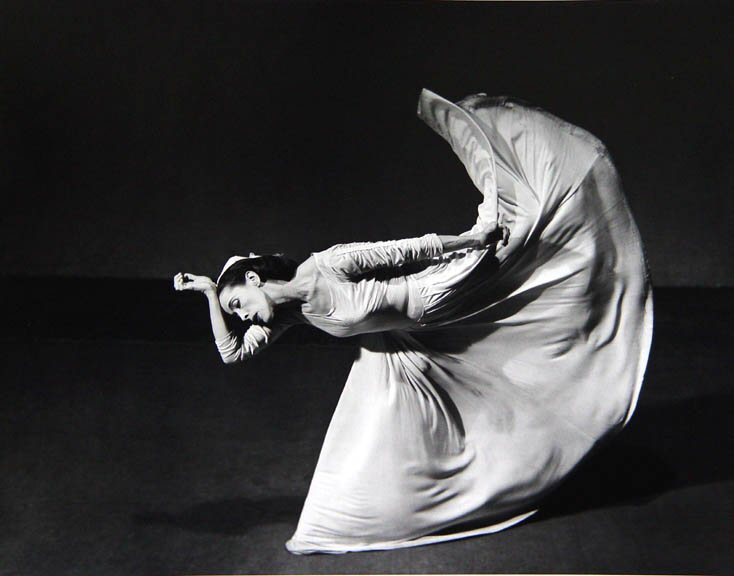
Fang-Yi Sheu as The One Who Dances in Graham's Letter to the World


Fanf-Yi Sheu in Letter to the World, photo by Christopher Duggan.
Fang-Yi Sheu is one of the finest Graham dancers of this generation. She is no longer a member of the Graham Company but often returns as guest artist. On 6th of August 2011 at the Gerald Ford Amphitheatre she performed the opening solo from Graham's Letter to the World, as reconstructed by the Company artistic director, Janet Eilber. Here is the link to the video recording done by Sergei Krasikof.

It is a very precious video as it gives a glimpse of what the piece could look like today. The Graham Company has, in fact, not recosntructed and performed it since 1988 and the only video available to the public is in black and white at the New York Public Library for the Performing Arts, with a stunning Pearl Lang in the title role.

This solo presents the main character as a lively and inexperienced girl in search of her path. She moves in different directions, runs, stops, moves again. She performs some beautiful turning jumps that are highlighted by her wide skirt, bends her torso forward several times and dances a brief section at the bench (during the piece she will return to the bench in more than one occasion). It a real joy to be watching this section in colour (I have studied the black and white video for my research)!

This readapted solo (there are variations and changes here and there) stands up as a nicely crafted choreographic piece and is very precisely danced by Fang-Yi Sheu, but, at the same time, we need to remember where it comes from. In the piece, the One Who Dances was with the One Who Speaks before beginning her solo. Her presence is only evoked through Dickinson's quoted lines: "Not knowing when the dawn will come, / I open every door", taken from poem 1619. The presence of the One Who Speaks is very important and instrumental to the developemnt of the piece. She is the other Emily, the speaking Emily, the one who moves more sedately but with equal force. And the lines are very important too. They convey the evolution of the main character's "inner journey", as Graham would say.

I am very pleased about this little choreographic passage and hope Letter will soon be reconstructed in its entirety. 


Wednesday, 13 November 2013

On the term 'choreosophy'


The term 'choreosophy' derives from Greek 'χορός' (choros, dance) and 'σοφία' (sophia, knowledge) and indicates a layered system of knowledge that we have on dance. The term joins together the word 'dance' and 'knowldge', as if to imply that the art of dancing is capable of producing knowledge, an important aspect if we think that still today many people tend to limit the meaning of dancing to the mechanical movement of the body (which could also be a topic for discussion, but not in this article).

The term 'choreosophy' was used by dance theorist Rudolf Laban in his book Choreutics (1966), together with other terms such as choreography and choreology, on which I will return in another article. Laban mentions its use in ancient Greece: "choreosophy seems to have been a complex discipline in the time of the highest Hellenic culture" (Laban, 1966: viii) and he also talks about its use in Pythagoras's work (the word 'choros' also means circle).

In another book, The Art of Movement (1950) Laban had also coined the poetic expression "movement-thinking" where again a term like 'movement' was put next to 'thinking' to suggest that dancing can be connected to the intellect and can move the articulation of thoughts.

The term 'choreosophy' returns in choreographer Aurel Milloss's writings as he defines it "the discipline that deals with dancing from a moral point of view" (Milloss, 2002: 64). In this case, then, the word 'knowledge' is interpreted in a different manner with respect to my definition. Milloss goes on specifying that choreosophy "intends to analyse the apparitions and manifestations of dance in human life" (Milloss, 2002: 64), giving a mystic tinge to the term. Dance, in his vision, is seen as the art from which the other arts originated as they all share a movement of some sort, "from the rhythm of movement came dance, from the rhythm of words, verses, from the rhythm of sound singing and music" (Milloss, 2002: 65). Having the other arts derive from dance is not new, Curt Sachs had already expressed this notion in his World History of the Dance (Tomassini in Milloss, 2002: 65). Establishing a hierarchical scale among the arts in the present academic panorama where Deleuze's molecular philosophy is widespread and where the binary vision of reality is being questioned, does not make sense and I will not venture on a digression of this kind. Suffice it to say that to Millos choreosophy is an analytical instrument connected to dance as a human phenomenon.

The word 'choreosophy' can also be found in Alessandro Pontremoli's writings about the fathers and mothers of contemporary dance, as he defines their work using the expression "choreosophic thinking"(Pontremoli, 2004: xxi). He also mentions it when talking about Laban, stating that choreosophy is the "philosophy of dance" as it "establishes its ethical and aesthetical principles" (Pontremoli, 2004: 70).

Recently, the term 'filmosophy' has been created and Daniel Frampton has written a book about it, Filmosophy published in 2006. Frampton highlights the fact that films do not only reproduce reality but create a new one (Frampton, 2006: 5). Films have produced a new way of thinking

(Frampton, 2006: 7) so that the necessity has come to reflect on them in terms of 'mind' and 'thinking'

(Frampton, 2006: 10). His discourse is quite interesting, but seems to fall back into the mind/body dichotomy, for example omitting the analysis of film materiality. The term 'filmosophy' is for Frampton exclusively connected to intellectual questions, while choreosophy, as we have seen, focuses on knowledge that dance can produce integrating mind and body in a refined synergy.

I believe it would be more appropriate to use the term 'choreosopher' instead of 'choreographer', when talking about great figures in dance history (and maybe not only them) who have developed a choreo-thinking within their work, (in the twentieth-century we can mention Martha Graham, Merce Cunningham, Trisha Brown, Anne Teresa de Keersmaeker, Tero Saarinen and the Abbondanza Bertoni Company), as this would express a more articulated picture of their vision.

Dance has its own terminology and 'choreosophy' is one of the less used but most stimulating terms to underline the complex research that surrounds the moving body.

(Note: tranalsations from Italian are mine. This article was originally written in Italian and published here)


REFERENCES

Daniel Frampton, Filmosophy - A manifesto for a radically new way of understanding cinema (London: Wallflower Press, 2006).

Rudolf Laban, L'arte del movimento [o.e. 1950], trad. Silvia Salvagno (Macerata: Ephemeria, 1999).

Rudolf Laban, Choreutics, edited by Lisa Ullmann (London: MacDonald&Evans Ltd., 1966).

Aurelio Milloss, Coreosofia - Scritti sulla danza, edited by Stefano Tmassini (Venice: Leo S. Olschki, 2002).

Alessandro Pontremoli, La danza. Stroria, teoria, estetica nel Novecento (Bari: Laterza, 2004)

Tuesday, 12 November 2013

Lecture performance on Martha Graham (photos)

Nooz and Rosella Simonari, photo Cristiano Marcelli.

Simona Ficosecco, photo Cristiano Marcelli.

Poster of Macerata ospitale festival, 2011.
These are two pictures from the lecture performance on Martha Graham that I deliveredin Civitanova March on September 17th, 2011. The third image refers to the festival that included my lecture performance among other events. Here is the link to the press release of the lecture and here are some more photographs from the event.

Duncan - Graham (press release and tour report)

Leaflet of the Macerata date.
 Isadora Duncan (1878-1927) and Martha Graham (1894-1991) are two fundamental North American dancers and choreographers in dance history and Western culture. they have influenced and fascinated artists, intellectuals, singers and actors such as Auguste Rodin, Andy Warhol, Edward Gordon Craig, Liza Minnelli, Gregory Peck and Woody Allen.
Rosella Simonari, photo M.T. De Roberto.


Duncan became famous as a bare-feet dancer who danced in Greek-like tunics, while the second had a tremendous impact on the audience thanks to her dramatic style centred on the movement of the torso. The former has initiated what has been defined a 'Copernican revolution' with her notion of dance in open opposition to ballet and with her fluid and 'natural' style, while the latter has further developed Duncan's legacy to forge an innovative dance technique and a large number of choregraphic works, many of which are considered masterpieces.
Both of them were charismatic and independent women, both believed that dance should not just be an entertaining art form, but also a way to reflect on the world, on women and on the dynamics of the human soul.

 The lecture performance, created by dance historian Rosella Simonari, intends to celebrate these two figures comparing passages from their writings, passages that will be read by Maria Chiara Teodori with Alessandro Fiordelmondo's specifically composed music, and that will be commented by Simonari herself.

A scene from the Jesi (ancona) date, photo Maria Teresa De Roberto.
This lecture performance had its debut at the Libreria Labotto in Jesi (Ancona) on March 8th, 2012 (photos here); it was then presented at Il Pozzo in Macerata on August 2nd, 2012 (photos here) and at the Cingoli Dance Festival in Cingoli (Macerata) on July 5th, 2013 (photos still to be uploaded).

Saturday, 31 August 2013

How it all began


My research project on Letter to the World began in the mid 1990s with my decision to dedicate the final year dissertation of my degree in Foreign Modern Languages and Literatures (Laurea) to the relationship between Martha Graham and North American literature. I still remember when I saw the Italian translation of Graham's autobiography, Blood Memory (see photograph) on the window of one of the bookshops in my hometown. I bought it and discovered a mystic and fascinating world.
I shyly asked  my professor if I could concentrate on Graham for my dissertation and she replied that she had been thinking of suggesting a research project on Graham for a while so that my journey started under a good omen. I dedicated the last chapter of my work to Letter to the World, and I immediately realised that it was worth a much deeper analysis.
Since then I have never stopped analysing this dance which still today emerges as a masterpiece of elegance and introspection.

Saturday, 18 May 2013

Letter to the World - technical info

Choreography: Martha Graham
Texts: Emily Dickinson
Dancers: Martha Graham and her Company
Music: Hunter Johnson
Set: Arch Lauterer
Costumes: Edythe Gilfond
Premiere: 11 August 1940, Bennington College Theatre, a new quite different version was done in 1941. This second version has become the version the Company has reconstructed in subsequent decades. In 1988 the Company has reconstructed it for the last time.
Video: here the reconstruction of the opening solo of The One Who Dances interpreted by Fang-Yi Sheu.
Photo: here, here, here, here.

Letter to the World is inspired by Emily Dickinson's poetry and personality. Two are the protagonists, The One Who Dances and The One Who Speaks, the first dances the most beautiful phrases in the piece, while the second utters lines from the poet's poems and letters. The other characters represent aspects of her personality and icnlude The Ancestress, who embodies Puritanism and death, The Lover, who is an actual lover and her connection to the world and March who interprets her lively wit. The main narrative thread presents the dancing protagonist engaging a fight with The Ancestress to affirm her creative independence.