Thursday, 19 May 2016

Spadolini, Ancona and the World

Italia Nostra, Teatrino San Cosma, Ancona, 14 April 2016, h 5.15 pm

An image of the audience.
Alberto Spadolini is still today an artist to be rediscovered, and the event, Alberto Spadolini, un anconetano nel mondo [Alberto Spadolini, a man from Ancona who got his way into the world], organised by Italia Nostra, has been a nice initiative that has remembered him from various perspectives. Marco Travaglini, Spadolini’s nephew and tireless promoter of his rediscovery, opened the ball. After him, Federica Bozzarelli, restorer of the artist’s work, followed and, in the end, I traced the path of his relationship with dance.
Marco Travaglini.
Travaglini spoke of Spadolini’s life, his illustrious friends, his work, and collaborations, underlining the fact that, in his investigation, many people and experts from all over the world, helped him. He showed numerous images of his extraordinary photographs and of his paintings, focusing, among other things, on the codes present in some of them, as his friend and main oral source of his rediscovery, Alex Wolfson, has noted. In this sense, Travaglini highlighted the importance of the sphere analyzing it in some paintings, as Tau, which seems to exemplify the history of the artist's soul. Spadolini, who was from Ancona, loved his town, he loved talking the Ancona dialect, and loved going back to Ancona to go to the market and eat the fish broth typical of the area. Before concluding his talk, Travaglini invited Mr. Mosconi, who knew Spadolini, to talk about his experience with him. He specified that he even knows where he was born, “in front of the barracks” in the ‘piano’ suburb, where the working class used to live.

Federica Bozzarelli.
Federica Bozzarelli focused on the restoration of Spadolini’s paintings, done, depending on each case, following different techniques, where she used scalpels to clear the canvas or colour paints to recreate the original luminosity and chromatism. She showed various paintings on which she worked both in their initial and final state. On a couple of occasions, she found other paintings under the canvas she was restoring, as the one they thought was a self-portrait and that instead they discovered was a portrait painted by Teodora Clerici Trmi, as is evident from an article published in Comoedia in 1933. 

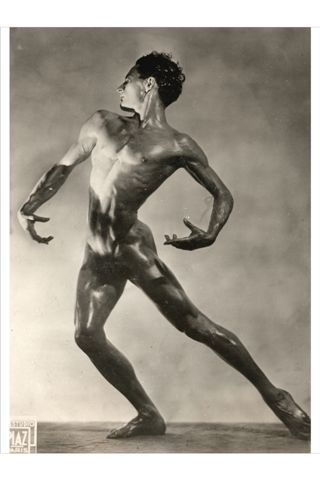
I talked about Spadolini as a dancer with a particular attention to his primitivist dances in 1930s Paris next, but not only that, to Josephine Baker. In particular, I have analysed one of his most significant photographs and illustrated aspects of his dance from his solo in the film Marinella (1936) directed by Pierre Caron, starring Tino Rossi as the protagonist.
Thanks to Italia Nostra for the organization of the event and to Marco Travaglini for asking me to take part to it. The rediscovery of Spadò, as he was also called, proceeds and will certainly continue to surprise us. 

Rosella Simonari and the audience.

Wednesday, 13 April 2016

Alberto Spadolini, un anconetano nel mondo


Tomorrow I will be in Ancona to deliver a brief talk on the relationship between Alberto Spadolini and dance, here an essay in Italian I wrote about it.

Tuesday, 22 March 2016

Adaptation and Dance Conference

Trinity House, Leicester.
Organised by the Centre of Adaptations, the Adaptation and Dance Conference, was held at Trinity House, De Montfort University, Leicester, United Kingdom, on 2 March 2016, and aimed at opening the debate on the subject. In the introductory talk, the two organisers, Elinor Parsons and Hila Shachar, noted how dance has always been dealing with adaptation and how 2016 represents a particularly fruitful year in that it marks the four hundredth anniversary of Shakespeare’s death, with the Birmingham Royal Ballet restaging of Frederick Ashton’s The Dream, based on Shakespeare's A Midsummer Night's Dream and the Northern Ballet choreographing of Charlotte Brönte’s Jane Eyre.
 
It  was cold, it rained, it also snowed and was sunny. In this respect, the English weather stood up to its reputation. Finding where the conference venue was, was not easy, but walking in Leicester was a beautiful experience and Trinity House a marvellous and very comfortable place, with nice rooms for the panels and the captivating old chapel for the opening talk and the final round table.

Conference opening.
I was in the panel on “Theorizing Adaptation & Dance”, chaired by Deborah Cartmell, which was thought-provoking and inspiring in terms of ideas and questions raised. Ramsay Burt’s paper, “Dance and Adaptation: Intermediality and Intertextuality”, focused on dance as an art form which develops across space and time in relation to other art forms, like music. He made the examples, among others, of Angelin Preljocaj’s peculiar Romeo and Juliet and JiÅ™i Kylián’s Symphony of Psalms of which he talked of as an adaptation of Igor Stravinsky’s music, an aspect which was brought again up during the discussion. Giannandrea Poesio’s paper, “Adaptation politics: the Risorgimento model”, highlighted the profound tie between nineteenth century Italian ballo and Italian politics. Italy was struggling on various fronts, among whose was achieving unity and these aspects influenced all the arts and contributed to develop a strong political tinge in the production of dance works.
 
My paper, “This Choreotext Which is Not One: On Dance Adaptation Theory”, was on the choreotext stauts in relation to dance reconstruction and adaptation theory and the last paper, “Dancing Figures. Rhetorical Devices in Dance”, by Begoña Olabarria Smith, dealt with the relationship between rhetorical figures and dance. The debate that followed was intriguing and posed some potential challenges to the field of adaptation studies, the most notable being the possibility for a dance adaptation not to include narrative and what role does the body’s “disruptive presence” play in narrative terms.  

One of the panels.
Other panels I went to presented interesting perspectives, like the one dedicated to “Cultural & Political Contexts” or the one on “Experimental Practitioners”. In the first, Miriam Hasikova's “The influence of the Political Regime on the Ballet Production and Adaptation of the Performances during the Communism in Czechoslovakia”, brought to life a little known but remarkable reality, while in the second, Christophe Collard's “Choreographing Continuity, Dancing Stein”, highlighted the complexity of Stein's work, The Making of Americans, and Juliette Mapp's multimediatic dance adaptation with a focus more on form than content and the consequent deconstruction of binary oppositions.

The final roundtable tied together some of the questions that emerged during the panels, like the relationship between dramaturgy and choreography, the significance of reception and the crucial importance of context for any dance adaptation analysis.

A nice wine drinking followed and then, a group of us, went to the Indian restaurant Kayal to continue talking about the conference in a more relaxed atmosphere.

Monday, 29 February 2016

Adaptation and Dance Conference

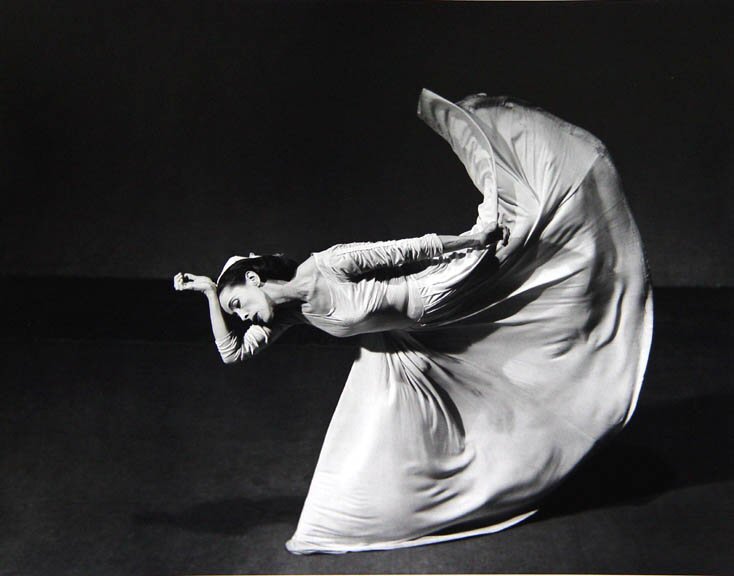
Martha Graham in Letter to the World, photo by Barbara Morgan.


Tomorrow, I will go to Leicester, UK, to take part to the Adaptation and Dance one-day Conference, on March 2, held at the Centre for Adaptations, De Montfort University. Here the link to the call for papers, the programme is still not online. My paper, "This Choreotext Which is not One: On Dance Adaptation Theory", is about the Choreotext status and its fundamental re-definition for Dance Adaptation Studies. To support my argument, I will draw examples from two significant dance adaptations, Martha Graham's Letter to the World (1940-41) and Antonio Gades's Carmen (1983).