Showing posts with label Alberto Spadolini. Show all posts

Thursday, 20 April 2023

Spadolini at the Fellini Museum


Alberto Spadolini, photo Dora Maar
  
In 1978 Marco Travaglini, Alberto Spadolini’s nephew, found a box filled with documents about his uncle. The box was put aside for years but in 2004, Travaglini began analysing those documents and was able to find many more. Quite a few of these documents are stunning photographs of Spadolini mainly in dance poses. Twenty-five of said photographs are now on display at the Fellini Museum in Rimini, Italy. The image chosen for the exhibition advertisement card is by Dora Maar and shows a graceful portrait of Spadolini, with a scarf around his neck and a small sphere in his left hand.

The exhibition opened on 24 March and was due to close on 16 April, but given the good response of the visitors, it has been extended until 1 May. On 30 March, 6 and 13 April the exhibition was also enriched by the screening of two documentaries: 2019 Spadò – Il danzatore nudo by Riccardo de Angelis and Romeo Marconi and 1951 Nous, les gitans by Alberto Spadolini himself.

I went to visit the exhibition on 13 April and was overwhelmed by the beauty of the photographs. Some of them have been published in my book on Spadolini (in Italian) and some in Travaglini’s books on his uncle. I commented the photographs for the visitors present that evening and seeing them all lined up was a feast for the eyes:

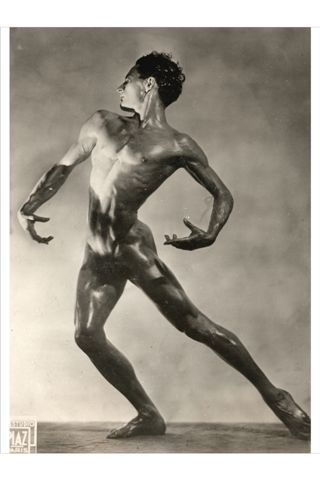
There was one of the very few images of Spadolini together with Josephine Baker where Baker is wearing a long tutu and ballet shoes, presumably for her ballet-insipred dances; there were some of the photographs portraying Spadolini as a nude dancer, like the one by Studio Piaz where he stands erect in a particularly virile pose; there was one portraying him in an Oriental costume, what I think might have been the costume for his work Cambodge, inspired by Cambodian culture; there were some dedicated to his Spanish-inspired dances, with a costume recalling that of a torero.

During the guided tour, ph. M. Travaglini
 Spadolini was a music hall dancer in 1930s Paris, but he also tried to move away from the music hall into theatre dance, as it happened with his 1933 Gala de danse, organised together with flamenco dancer Nati Morales.

The 2019 documentary presented a nice picture of Spadolini, with a focus on Travaglini’s 1978 discovery of the box, Spadolini’s ties with Gabiele d’Annunzio and his possible role as a spy during World War II. Here is the trailer (in Italian): https://www.youtube.com/watch?v=CVZlhLCvEgo

Spadolini’s own 1951 documentary was dedicated to Gypsy culture. There he appears in an interesting dance, in one of his almost nude attires. The documentary is also watchable online at the following link (it is in French): https://www.cinematheque.fr/henri/film/116989-nous-les-gitans-alberto-spadolini-1950/

This exhibition is an important event to celebrate Spadolini and his art as a dancer (he was also a painter, actor and a lot more) and I highly recommend it.


Saturday, 30 October 2021

My book in Italian on Alberto Spadolini


Nearly a year ago my book in Italian, Alberto Spadolini, Apollo della danza [Alberto Spadolini, Apollo of the Dance] was published by Affinità Elettive. Here is the translation of the book summary:

Alberto Spadolini (1907-1972) was a painter, dancer ad a lot more, but dance constitutes the fil rouge of his career. Born in a turbulent Ancona, he spent his formative years in Rome and had his debut in France in 1932, becoming famous as a music-hall dancer in La Joie de Paris, with Josephine Baker. In an interview he defines himself as ‘anarchist’ and in 1933 he performs in the Gala de danse, a performance of ‘pure’ dance where we can perceive an authorial line that distances him from the music-hall. In spite of the fact that he wears costumes of different kinds, he is classified as a ‘nude dancer’ by the press. This is due to his statuesque body that he shows in some dances. From the 1940s he begins to paint a series of paintings dedicated to ballerinas, recalling, in some aspects, Edgar Degas. Analysing even very rare documents, the present study explores the relationship Spadolini had with dance, illustrating another name with which he was known: Apollo of the Dance.

Thursday, 12 November 2020

Published my essay on Alberto Spadolini's archive


My essay "Alberto Spadolini's Box: Dance, Silence and the Archive" has been published by Dance Research. Here more details.

Friday, 6 December 2019

Alberto Spadolini - Galeotto fu il lenzuolo review


It is not easy to write about Alberto Spadolini: his archive includes heterogeneous documents, such as articles in different languages (among them French and Flemish) and photographs that it is difficult to place within his career. Marco Travaglini, his nephew and biographer, has uncovered material on his uncle since 1978 and has been studying it at least since 2004. Thanks to him Spadolini’s life has emerged from the fogs of oblivion. Alberto Spadolini - Galeotto fu il lenzuolo. Arte, amore e spionaggio nella Parigi Anni Trenta [Alberto Spadolini – It all started with a sheet. Art, love, espionage in 1930s Paris] is Travaglini’s latest book, a novel mostly based on documents. The title refers to Spadolini’s 1932 debut as a dancer. As he did not have a costume to wear, he chose a sheet which was valued for its originality. In many photographs, included Dora Maar’s refined portrait that has been chosen for the book cover, Spadolini wears various kinds of draped fabric (scarves, cloaks, etc.) as ornament, maybe as a memory of that debut.

Spadolini (1907-1972) was a famous music-hall dancer in 1930s Paris and, after that, an appreciated painter both in France and abroad. He was also decorator, singer, actor, restorer and director.

Travaglini opens the book quoting another novel on Spadolini, Il Gioco di Spadò [Spadò’s Game] by Augusto Scano, published in 2015. Spadolini is dying in a hospital and somebody (Death? A friend?) asks him to dance and invites him to do so as he has never done before. This is a significant introduction because, as I stated in 2007, dance represents a fil rouge in Spadolini’s career, even after he stopped dancing, in that it constantly returns in his paintings.

The narrative is divided into two main threads: one set in 2015 and dedicated to the fictitious character of Dora, an Italian American PhD in Renaissance art who is given the task to write a book about 1930s dance in Paris; the other is centred on Spadolini’s life that spans from the 1920s to the 1970s. Dora’s publishing house asks her to find “a key, a protagonist, something or somebody who can become the subject for a book”. Surprised, Dora discovers the exhistence of an unknown figure who has her same surname, “‘Josephine Baker and...Spadolini?’ But it is my same surname!”. Thus begins her adventure in search of Spadolini that will bring her to Italy and France in the company of archivist Maurizio.

Spadolini’s life flows through the pages thanks to recurrent flash-blacks that move the action to when the artist met Gabriele D’Annunzio and Anton Giulio Bragaglia in 1920s Italy, when he became a famous dancer in 1930s France, when he danced in front of Hitler in 1940, when he performed with Walter Chiari in Italy after the Second World War and so on till his last years.

Many of these flash-backs stand out for their historical interest. For example, the Spadolini-D’Annunzio connection poses some reflexions. On the one hand, historian Giordano Bruno Guerri considers it a possibility, on the other, he highlights the fact that there are no documents about it. In truth there are, but they do not come from the period during which they met, that is the 1920s [1] but from a lot later, 1971, when Philippe Jullian published his biography on the Italian poet. Maybe Guerri refers to the lack of primary sources (precisely those closer to the period of the event) and not to the presence of secondary sources as Jullian’s book is. A debate on sources would imply a long digression, but we can briefly analyse this one.

Jullian thanks Spadolini in the acknowledgment page but does not name him in the episode about his encounter with the poet at the Vittoriale. One wonders why. Did Spadolini explicitly ask for his name to be omitted? Why would he do that? Jullian was not an amateur writer: born as illustrator, he wrote some novels to then focus on art history and biographical studies. His book on Symboism, Esthètes et Magiciens [translated into English as Dreamers of Decadence] contributed to the rediscovery of that art movement. Some of his books, including his biography of D’Annunzio, have been translated into Italian. Jullian dedicates a couple of pages to the encounter between Spadolini and D’Annunzio, pages that do neither represent a fundamental aspect of the poet’s life nor a considerable portion of the book itself: he could have simply taken them away, but did not. Furthermore, as Travaglini has specified, this source has been confirmed by Patrick Oger who knew Spadolini well.

Considering Jullian from another perspective, we could look at what he actually does not say. In fact, when he thanks Spadolini, he calls him “the famous dancer” without saying anything about his paintings. Why? Exhibitions on Spadolini’s work had been organised since the 1940s, why did he omit this aspect? At present it is not clear, but we know that Spadolini had been deeply attached to his paintings since the 1920s, when he was studying art in Rome.

One of his first notable paintings was a San Francis he completed in 1925. At that time he could not keep it safe at his place in Rome and left it in Ancona, at his parents’ house. Unfortunately, his father Angelo, who had refused to join the Fascist Party, lost his job and decided to sell it. When he discovered it, Spadolini became very angry. He tried to recover his work and discovered that it had been sold to a church in Bradford, New York, USA. When he went on tour to the States, he hired a photographer to have a picture taken of his painting and this is all we have of it today. His attachment also emerges from his decision to join the Third Order of San Francis, probably after the Second World War. Travaglini dedicates an intense page to his uncle’s devotion for the saint, quoting his own words: “Francis has taught me to give for the joy of giving, to be happy with what I have, to consider the rich as the real poor because they are often poor in their spirit and soul”.

Spadolini’s words return in other parts of the book, as in his 1935 article, “Impressions of America”, that Travaglini published also in his 2012 book, Spadò – Il danzatore nudo. Spadolini talks about the United States after coming back from a tour there, “an American city shows itself as a continuous example of human velocity”. He compares the Parisian music-halls with those in the States, highlighting the fame of the French capital, “in general, when the production shows a French label, it is skyrocketing”. He then criticises North American racism, after noticing its “unspeakable repulsion towards the yellow and black races” while dining with black artist Alma Smith.

Dora and Maurizio discover information on Spadolini thanks to this and other documents, commenting them and formulating questions on his life. In this sense, Travaglini’s book is as much about Spadolini as it is abut the complex act of writing a book on him. Connected with this aspect, there is another character, a blogger who publishes superficial articles on Spadolini. His work, inspired by an exhisting book, Ignazio Gori’s Alberto Spadolini – Danzatore, pittore, agente segreto [Alberto Spadolini – Dancer, painter, secret agent], shows the great difference between a fourteen years (and counting) long study, as Travaglini’s book is, and Gori’s work, where Travaglini’s findings are mentioned (beginning with the 1978 box of documents) but never acknowledged. One could recognise its unprofessional approach even only from the book cover, where a beautiful photograph of Spadolini is turned upside down (what are possible readers supposed to think of it? That Spadolini danced that way?). Worse still, the book is described as the ‘study’ that gives back “its right weight” to Spadolini’s work , creating a false idea in those who do not know anything about either Spadolini or his nephew, a very grave and disrespectful act. Through the blogger character, Travaglini questions and deconstructs Gori’s book, reclaiming the respect that his own work and his uncle deserve, “‘Your blogger – vehemently said Dora - ‘alludes to something, but what proofs does he offer?’. ‘None!’, replied Maurizio”.


NOTE

[1] There is an indirect source from that period that attests Duilio Cambellotti’s presence at the Vittoriale. According to Pierfranco Andreani, who wrote a brief biographical introduction on Spadolini in the brochure of his Roman 1967 exhibition, Spadolini became Cambellotti’s apprentice while studying at the Art Academy in Rome. It is therefore plausible to think that Spadolini went with him to the Vittoriale.

Monday, 16 September 2019

Presentation of Spadolini documentary


On Tuesday 27, August 2019, in the Pinacoteca in Jesi (An), I presented an evening dedicated to dancer painter Alberto Spadolini where Riccardo De Angelis and Romeo Marconi' documentary, Spadò - Il danzatore nudo (2019) was showed, followed by a chat with the directors and Spadolini's nephew, Marco Travaglini. Here is my review of the documentary.
The Pinacoteca is becoming a reference point for the rediscovery of Spadolini as, thanks to my collaboration with them (mainly thanks to Simona Cardinali) on November 10, 2012, I organised and presented another event to celebrate Spadolini, Dalla tela al palco - Vita, pittura e danza di Alberto Spadolini, which consisted in a lecture performance done in collaboration with dj Nooz and dancer and choreographer Roberto Lori, and an interview with Travaglini and sculptor Massimo Ippoliti.
In February 2017, the directors shot the video interview they made with me in the Pinacoteca as well.
I therefore thank them for their help and kindness.


Thursday, 20 June 2019

Spadò – Il danzatore nudo: a documentary on Alberto Spadolini


 Official trailer of the documentary.

Attics sometimes reveal entire worlds, dusty and long forgotten. Spadò – Il danzatore nudo [Spadò: the nude dancer] opens in an attic, with a dusty, somewhat vintage atmosphere and a double bell alarm clock. Because this is a journey through time, the time when Alberto Spadolini, (1907-1972), a young boy from Ancona, Marche, went to live in Rome in the 1920s, where he studied painting and then moved again to France, where he became a famous music-hall dancer in 1932.

Spadolini’s rediscovery began in 1978 precisely in an attic, where his nephew, MarcoTravaglini found a box filled with documents of all sorts (photographs, articles, posters etc.) about his uncle’s life in France. Spadolini did not really talk of his role as dancer and Travglini was surprised at what he discovered. He went back to this material in 2004 when he methodically started to search for his uncle’s secret past. The documentary creates an evocative atmosphere as Travaglini speaks in the attic, “every now and then our particularly mysterious uncle would come (…) he was very loved and would come to visit us once or twice a year. He would come in a big enormous American car" with presents for his nephews.

Riccardo De Angelis and Romeo Marconi have directed the first documentary on this little known artist, in collaboration with Marco Travaglini, who is also the director of Atelier Spadolini. Spadò was the nickname with which Spadolini was called by his friends and sometimes by the press. The title also refers to the fact that he often danced almost nude and should not be confused with Travaglini’s homonymous 2012 book title. This documentary is a fascinating journey divided into three intertwined planes: one centred on material on and by Spadolini, another represented by people who either knew him (his nephews and a friend) or know about him (a journalist, a writer, an art historian, myself as dance historian etc.), and the third one made by the Nicoletta Fabbri Quartet’s Paris-inspired music (one member of the Quartet is Stefano Travaglini, Marco's brother).  

Journalist and writer Alberto Bignami brings us to Spadolini’s birth as a love child: his mother, Ida, was working as a maid in the house of an aristocratic family, had an affair with her master, got pregnant and was fired because of that. She was about to leave Ancona, when railway worker Angelo Spadolini, earned her trust and welcomed her and her baby in his house.

Writer and philosopher Antonio Luccarini tells us that young Alberto showed a gift for drawing and started studying painting with local artist Armando Bandinelli. He then moved to Rome to study with Vatican painter Giambattista Conti. In the capital he attended Anton Giulio Bragaglia’s Teatro degli Indipendenti where many avant-garde artists were. According to art historian, Stefano Papetti, Spadolini “surely deserves (...) to be better investigated”. There is a dynamism pervading his painted figures that may come from his contact with the futurist painters that he probably met at the Teatro.

A good part of the documentary is devoted to the supposed friendship betweeen Spadolini and Gabriele D’Annunzio, about which Travaglini has talked since his first book on his uncle, Bolero-Spadò: Alberto Spadolini, una vita di tutti i colori (2007). Art historian, biographer, illustrator Philippe Jullian thanks Spadolini in the acknowledgment page of his 1971 book on Gabriele D’Annunzio, “Spadolini, the famous dancer, has told me about the trip he made to the Vittoriale when he was very young”. The Vittoriale degli Italiani is a set of constructions promoted by D’Annunzio in Gardone Riviera in the North of Italy. There he spent the last part of his life and there he apparently met Spadolini in 1924. Jullian does not explicitly name him, in the book, but when we read of a young decorator who becomes D’Annunzio’s friend and then goes to France, we can easily make the connection with the reference the author has previously made in the acknowledgment page. This connection has been corroborated by one of Spadolini’s friends, Patrick Oger who has confirmed to Travaglini that the young decorator in Jullian’s book is Spadolini. In the documentary, historian and biographer Giordano Bruno Guerri, who has written on D’Annunzio, highlights the possibility of this encounter even though the sources are not consistent enough.

Poster of the documentary.
Another aspect of Spadolini’s life which lacks consistent sources is his possible role as secret agent. Writer and essayst Fabio Filippetti, states that when one talks about the secret service “it is difficult to gain information”. However, Spadolini was a known artist and could move in different places without arousing suspects. And the intersting thing is that “we find him (…) in strategic cities in particular during the [Second] World War”. Travaglini explains his view on the matter quoting, among other elements, the friendship between Spadolini and codex enthusiast Ives Gilden. It is possible that further material will emerge with time.

I had the task of speaking of the role of Spadolini as dancer. I was quite nervous during the interview and did not say as much as I wanted. I called Spadolini a primitivist dancer as he performed in various acts inspired by those cultures that at the time were seen as primitivist. Primitivism is a complex, colonial and controversial notion that invests various fields such as art and literature. At the turn of the twentieth century it had to do with Westerns’ fascination for the Others whose works began to be considered as art and inspired many Westerners’ artistic forms. Pablo Picasso’s Les demoiselles d’Avignon is the recurrent example, in this sense. I did not refer to these aspects in my interview, but De Angelis and Marconi focused on one of Spadolini’s few recorded primitivist performances, his solo in 1936 Pierre Caron’s film, Marinella. There Spadolini moves nearly nude on a small stage in the shape of a drum, recalling perhaps a primitivist culture ritual and mingling diverse dance techniques such as classical dance and flamenco. Spadolini was also famous for his Bolero that he probably presented in 1933 and that was set to Maurice Ravel’s music and was noted for his interpretation in Gigue to Bach’s music, the same year.

In the documentary Luccarini emphasises how Spadolini became a dancer “without any technical knowledge” and before that I quote Jenny Josane’s 1941 article where Spadolini himself confirms that. However, there are other sources that state otherwise and it is very likely that he studied dance during his Roman period. Furthermore, after his 1932 debut at the Casino de Paris, he also started taking classes from two ballet teachers, Alexandre Volinine and Blanche D’Alessandri.

Of particular interest is Sergio Sadotti’s testimony. He knew Spadolini in the years 1957 and 1958 when the artist would go to Porto Sant’Elpidio to visit his sister who lived under his flat, “Alberto immediately stood out for his personality, a great personality and elegance (…). I saw him paint paintings that he would quickly roll and send to his gallerist in Paris.”

These and other interviews are all blended in with beautiful images of Spadolini’s statuesque presence and of Paris. More specifically, video fragments from his own black and white 1950 documentary, Rivage de Paris, flow and reveal monuments of the city such as the Eiffel tower as well as its musicians, like an accordion player whose image is elegantly juxtaposed to that of the Nicoletta Fabbri Quartet. One of the songs the Quartet plays is Josephine Baker’s 1930 “J’ai deux amours”, which is apt for Spadolini too, as it recites, “I have two loves, my country and Paris”.

De Angelis and Marconi have done a really significant and at times superlative job thanks also to Travaglini’s archival support. Spadò – Il danzatore nudo, which is also available with English subtitles, is an important work, another step towards a better comprehension of Spadolini’s enigmatic figure.

Thursday, 9 June 2016

Italy and the Classics

Tomorrow I will be in Oxford to take part to the one-day conference Italy and the Classics. My paper is about dancer painter Alberto Spadolini. Here is the programme. Here more details.


Thursday, 19 May 2016

Spadolini, Ancona and the World

Italia Nostra, Teatrino San Cosma, Ancona, 14 April 2016, h 5.15 pm

An image of the audience.
Alberto Spadolini is still today an artist to be rediscovered, and the event, Alberto Spadolini, un anconetano nel mondo [Alberto Spadolini, a man from Ancona who got his way into the world], organised by Italia Nostra, has been a nice initiative that has remembered him from various perspectives. Marco Travaglini, Spadolini’s nephew and tireless promoter of his rediscovery, opened the ball. After him, Federica Bozzarelli, restorer of the artist’s work, followed and, in the end, I traced the path of his relationship with dance.
Marco Travaglini.
Travaglini spoke of Spadolini’s life, his illustrious friends, his work, and collaborations, underlining the fact that, in his investigation, many people and experts from all over the world, helped him. He showed numerous images of his extraordinary photographs and of his paintings, focusing, among other things, on the codes present in some of them, as his friend and main oral source of his rediscovery, Alex Wolfson, has noted. In this sense, Travaglini highlighted the importance of the sphere analyzing it in some paintings, as Tau, which seems to exemplify the history of the artist's soul. Spadolini, who was from Ancona, loved his town, he loved talking the Ancona dialect, and loved going back to Ancona to go to the market and eat the fish broth typical of the area. Before concluding his talk, Travaglini invited Mr. Mosconi, who knew Spadolini, to talk about his experience with him. He specified that he even knows where he was born, “in front of the barracks” in the ‘piano’ suburb, where the working class used to live.

Federica Bozzarelli.
Federica Bozzarelli focused on the restoration of Spadolini’s paintings, done, depending on each case, following different techniques, where she used scalpels to clear the canvas or colour paints to recreate the original luminosity and chromatism. She showed various paintings on which she worked both in their initial and final state. On a couple of occasions, she found other paintings under the canvas she was restoring, as the one they thought was a self-portrait and that instead they discovered was a portrait painted by Teodora Clerici Trmi, as is evident from an article published in Comoedia in 1933. 

I talked about Spadolini as a dancer with a particular attention to his primitivist dances in 1930s Paris next, but not only that, to Josephine Baker. In particular, I have analysed one of his most significant photographs and illustrated aspects of his dance from his solo in the film Marinella (1936) directed by Pierre Caron, starring Tino Rossi as the protagonist.
Thanks to Italia Nostra for the organization of the event and to Marco Travaglini for asking me to take part to it. The rediscovery of Spadò, as he was also called, proceeds and will certainly continue to surprise us. 

Rosella Simonari and the audience.

Wednesday, 13 April 2016

Alberto Spadolini, un anconetano nel mondo


Tomorrow I will be in Ancona to deliver a brief talk on the relationship between Alberto Spadolini and dance, here an essay in Italian I wrote about it.