My article, "This great stage of fools: Martha Graham's dance 'Notes for a Study of Lear'" has been published on the European Journal of American Culture some months ago. Here is the link to the abstract and other details.
My essay, "Martha Graham's Letter to the World: A dance adaptation of Emily Dickinson" has been published last June on the Journal of Adaptation in Film & Performance, Vol 12, Ns 1-2, 1 June 2019, pp. 33-48. In it I analyse Graham's Letter as a dance adaptation, to show how she converted Dickinson's poetic (and not just poetic) material into dance. I also briefly focus on the notion of dance adaptation itself.
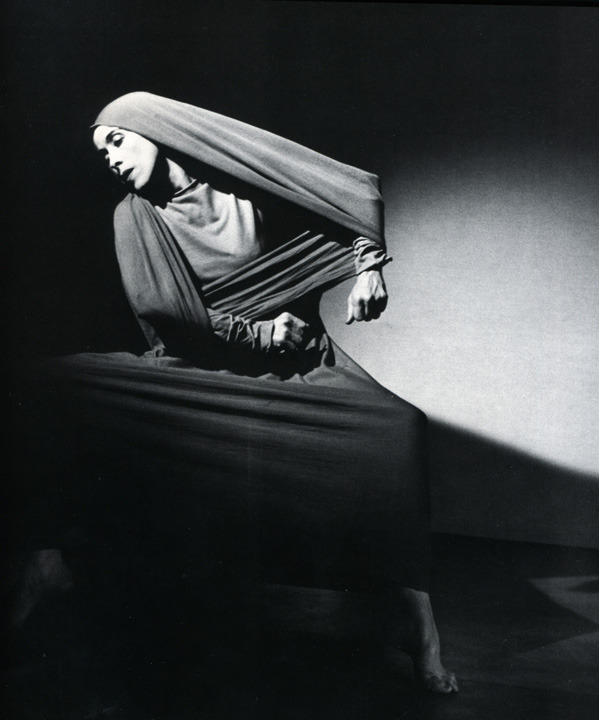
Martha Graham in Letter to the World, photo Barbara Morgan, 1940.
Torso placed in parallel position with the floor, one arm following its line, the other bent, its wrist on the dancer’s head. Her eyes are closed and the tension of her movement is visible through her exposed neck. The wide skirt of her white dress defines the movement of her legs, one being rooted on the floor and the other forcefully thrown behind her in a striking kick. Both the horizontal line of her torso and the vertical curve of her skirt contribute to the kinetic idea of her step.
The dancer in question is Martha Graham, the photographer Barbara Morgan. The former fundamentally contributed to the revolution operated by modern dance in the first half of the twentieth-century, the latter immortalised some of her most memorable dances in carefully constructed images. In particular, this photograph has become what I will call The Photograph, probably the most famous picture of Martha Graham. It relates to Letter to the World (1940-41), a choreography she dedicated to poet Emily Dickinson, a complex work she was prticularly attached to. In the course of various decades, this image has undergone various transmutations.
First, its relation to the choreography is paradoxical. The Photograph has reached an iconic status, all those who know Graham, have seen it and if one googles her, this is most likely the first picture to come out. In spite of this, Letter to the World is almost unkown. Few scholars have dedicated a thorough analysis to it and the public is little aware of its existence.
Barbara Morgan's book, 1941.
Secondly, it shows how “technological intervention” changes “the representation of movement” (Salazar Sutil, 2015: 1). The art of photography has focused on the representation of movement, for example, with the work of Eadweard Muybridge who studied the locomotion of animals and individuals at the end of the nineteenth-century. Muybridge used many cameras to capture motion and contributed to the development of early cinema with his projector called zoopraxiscope.
Barbara Morgan’s photograph is taken from a celebrated volume, Martha Graham: Sixteen Dances in Photographs, published in 1941 and republished in 1980. Morgan’s aim was to document dance, and make “possible the fuller portrayal of the dancer’s fugitive art” (Morgan,1980: 12) . She was aware of the fact that her medium could not convey movement per se, but she intended to highlight “the dance at its visual peak” (Morgan, 1980: 12) and chose the photographs of those gestures she better remembered and that came “to symbolize the whole dance” (Morgan, 1980: 150). In sum, those images are Morgan’s perspective on the dance and The Photograph a substantial part of its significance, in that it has frozen movement into a frame, erasing its kinetic component. Its enourmus diffusion has, in the course of the decades, altered “the perception” (Benjamin, 1999: 734) of the piece which is now condensed into this very frame.
What does The Photograph tell us of Graham’s choreography? What does it say of her approach to movement? It tells us a great deal, but it still represents a part, a glimpse of a highly layered work. Letter to the World is not a biographical account of Emily Dickinson’s life, but rather an incursion into the “inner landscape of her poetry” (Graham, 1991: 163). Structured into five episodes, it presents the poet’s identity through two figures, the One Who Dances, originally interpreted by Graham herself, and the One Who Speaks, danced by Jean Erdman, whose task was to move and utter lines from Dickinson’s poems and letters. The other characters are emanations of the poet, such as the Ancestress, portrayed by Jane Dudley, who exemplified the poet's Puritan heritage and death, and the Lover, danced by Erick Hawkins, who represented Love. The One Who Dances engages in a fight against the Ancestress and when the latter separates her from the Lover, she performs a long solo which consists of various sequences danced on the floor, on the bench present onstage and across space. During this part, the One Who Speaks utters numerous lines, following the protagonist in her path of rebirth (Simonari, 2015).
The Photograph comes from this final solo and sums up the One Who Dances’s inner struggle, with her bent torso and wrist on her head. It freezes the movement phrase transforming it into a profound pensive gesture. The back kick adds a dynamic element, a spatial opening that destabilises the rigor of her upper body position giving strength and stamina to the pose and to the character it pictures. It also expresses some crucial aspects of the Graham technique like gravity which is seen as a force to be explored and not contrasted. In The Photograph, even if it is hidden by the fabric of the skirt, the foot that carries the weight of the body is firmly planted on the floor and almost seems to be an attracting drive for the torso and its peripheral limbs.
Andy Warhol, The Kick, 1986.
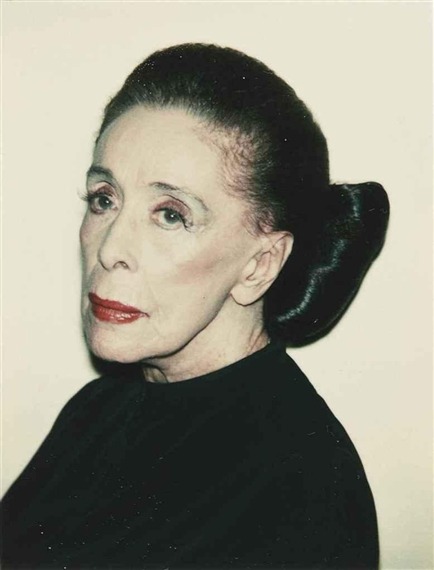
Thirdly, there is the afterlife of The Photograph as it has been reinvented in unusual manners. One of its most famous interpretations is Andy Warhol’s screenprints. Warhol had been drawn into dance in general on various occasions. At the beginning of the 1960s, he created the Dance Diagrampaintings, where he showed some steps of the Charleston or Foxtrot as seen from above, focusing on the dancer’s feet. He also attended the performances of the Judson Dance Theatre where he met dancer Fred Herko who subsequently starred in some of his earliest films. In 1979 he shot a few polaroid photographs of Graham, focusing on her head and shoulders. She is not in a dancing pose, but shows her face or her profile. Between 1981 and 1986, Warhol made some drawings of Graham dancing, drawings inspired by Barbara Morgan’s photographs of, among other works, Frontier (1935), Satyric Festival Song (1932) and Letter to the World. In 1986 he produced a series of screenprints based on Morgan’s photographs of Graham in different dances, among whose there was The Photograph. He transformed it using colour, highlighting the perimeter of the figure and juxtaposing more than one image of The Photograph into one single picture. The title given to these works is The Kick which metonymically paraphrases Graham’s movement [1].
In 2007 illustrator Vladimir Radunsky published the children’s book Because… in collaboration with Mikhail Baryshnikov, who wrote the story. Centred on a dancing grandmother, among the dancing poses she assumes, there is her 'interpretation' of the The Photograph. In this case, then, Graham is not the protagonist of the image, but her move is. The dancing grandmother wears a white top and a black wide and long polka dots decorated skirt which draws the same curve of the original, one arm bent with her wrist on her hatted head and the other kept straight along her torso. The tension of The Photograph is not the same but the construction of the lines are. This tells us that The Photograph has become a consistent part of North American culture and that Graham’s pose has gained a life of its own.
In 2015 The Photograph has once again been reinvented in two shots by the New York Dance Project. Created by fashion photographer Ken Browar and photo editor with a dance background, Deborah Ory, the project is about celebrating the New York based dance world with quality artistic photographs. The two shots in question show the same movement but with a different, more airborne nuance. One portrays Peiju Chien-Pott, who has been a member of the Martha Graham Dance Company from 2011 to 2016, wearing a Diane Von Furstenberg floral dress, while the other shows American Ballet Theatre principal dancer Isabella Boylston, whose weight-carrying leg stands on pointe.
Peiju Chien-Pott stands on half point and her weight-carrying leg is partly revealed as the skirt of the dress, which is wide and long, moves upward redefining the curve of Morgan’s photograph into fabric ondulations. The sense of gravity from Morgan’s photograph is changed into an upward drive only partially contrasted by the dancer’s horizontally placed torso. This drive becomes a vertical pattern in Isabella Boylston’s version where we have a double kinetic retake, one that relates to Graham’s so called kick movement, and the other stemming from a different technique from Graham’s, that is ballet. The ballerina’s torso is no longer in parallel position with the floor, but in a slightly tilted posture that creates a diagonal line. Her pointed foot is well grounded on the floor but it is pointed nevertheless, thus placing her on a higher plane with respect to Graham. Her bent arm and wrist are almost in the same position and this, together with her lifted leg, expresses a melancholic mood that in part erases the dramatic force in Graham’s version.
NOTE
[1] In an article about Morgan, The Photograph is also referred to as The Kick.
NOT LINKED REFERENCES
Walter Benjamin, “The Work of Art in the Age of Mechanical Reproduction”, in Film Theory and Criticism. Introductory Readings, Leo Braudy, Marshall Cohen, edited by (Oxford: Oxford University Press, 1999), pp. 731-751. Frontier, chor. Martha Graham, music Louis Horst, set Isamu Noguchi, costume Martha Graham, feat. Martha Graham (New York, Guild Theatre, 28 April 1935).
Letter to the World, chor. Martha Graham, texts Emily Dickinson, music Hunter Johnson, set Arch Lauterer, costumes Edythe Gilfond, feat. Martha Graham, Margareth Meredith, Jane Dudley, Erick Hawkins, Merce Cunningham and Company (Bennington, Bennington College Theatre, 11 August 1940).
Letter to the World, chor. Martha Graham, texts Emily Dickinson, music Hunter Johnson, set Arch Lauterer CHECK, costumes Edythe Gilfond, feat. Martha Graham, Jean Erdman, Jane Dudley, Erick Hawkins, Merce Cunningham and Company (New York, Guild Theatre, 7 April 1941).
Barbara Morgan, Martha Graham: Sixteen Dances in Photographs (New York, Morgan & Morgan, 1980).
Nicholás Salazar Sutil, Motion and Representation. The Language of Human Movement (Cambridge: MIT Press, 2015).
Satyric Festival Song, chor. Martha Graham, music Imre Weisshaus, costume Martha Graham, feat. Martha Graham (New York, Guild Theatre, 20 November 1932).
Rosella Simonari, Letter to the World. Martha Graham danza Emily Dickinson (Rome, Aracne, 2015).
On November 27 I was in Bari at the Libreria Zaum to talk about my book, Letter to the World: Martha Graham danza Emily Dickinson.
The talk was coordinated by my friend and dramaturg Valeria Simone.
Unfortunately the train was monstruously delayed because of a river
flooding. However, once I reached the bookshop, there were still
numerous people waiting for me. It has been a really beautiful chat, I
thank the bookshop wholeheartedly for welcoming me, Valeria Simone
for guiding the conversation in such an apt manner and Angela D'Ottavio
and Annarita Taronna for helping with the organisation. Here are a couple of photographs.
In 2011, Jacquelyn Elder, Katherine Crockett and Tadej Brdnik, members, at the time, of the Martha Graham Dance Company, reworked their own adaptation of Graham’s 1930
Lamentation in the form of a video. Elder directed it, Crockett performed the
solo and Brdnik, who had the idea in the first place, produced it. It was an
entirely self-funded project and stands out as a remarkable dance adaptation of
one of Graham’s greatest works.
To begin with, it is a video and not a live performance, thus allowing the audience to watch it over and over again even from their own house. Then, the soundscape is particularly unique, in that it is a mixture of sound, underground trains’ noises and Crockett’s voiceover, which brings it into the twentieth-first century and yet keeps a firm bond with its adapted choreotext. Third, the uncommon location where it was shot, the New York underground Christopher Street – Sheridan Square Station, removes it from its usual set, the theatre stage, to insert it in the pulsating heart of the metropolis, the underground.
Lamentation
is a solo Graham choreographed and performed in at Maxine Elliott’s Theatre,
New York, on 8 January 1930. It lasts less than six minutes and features a
dancer wrapped in a purple tubular stretch costume that hides her body except
for her face, part of her torso, her hands and feet. As the title suggests, it
is a kind of lament, exemplified by the restrained movement quality, which is
limited and, at the same time, highlighted by the costume. However, it is not
about a grieving woman, but about the notion of grief expressed through
movement. The dancer sits most of the time on a bench, thus destroying “the conventional image of the dancer” (Marica Siegel,
1979: 38) which is usually connected to movement performed across space. In Lamentation,
instead, the energy is all concentrated on that bench.
The
stretching nature of the costume shapes and reshapes the human body according
to unusual forms. Graham associated the piece to “the ability of stretching
inside your own skin” (Martha Graham, 1991: 117) and the costume does recall
the thin and organic texture of a person’s skin. At the same time, it deeply moves
the audience as the dancer performs its simple and yet striking gestures: arms
forward, arms up, arms joined in prayer, feet up and down, torso slightly
moving. To confer a visual idea of what the piece was and is about, I chose two of Barbara Morgan's
photographs for this article and two videos, one featuring Graham dancing it in
1943 (fragments, silent video), the other Peggy Lyman, from the Graham Company,
dancing it for the Dance in America 1976 TV series (complete solo, with music).
Lamentation
is still today a work of art made of synthesis and simplicity, two concepts Graham
was focusing on in the 1930s when her approach to dance was mainly dealing with
solo and group works, “as to form, which is the heart, there is manifest an
economy of gesture, an intensity and integrity of mood, a simplified external
means, and above all a concentration on ‘the stuff’ of the dance, which is –
movement divinely significant” (Martha Graham, 1930: 254). This solo stands for
what modern dance was trying to achieve in the 1930s, a new vision in terms of
form and content, a vision which was rooted in the time and space those dancers
were inhabiting, like the Depression and the World Wars. These events, modern
dancers found, could not be expressed with the type of dance language (ballet
and vaudeville, for example) that was available at the time. A new language, a
new form was necessary. Lamentation exemplifies these aspects and adds many
more. That is why, along the years, it has been recreated and reinterpreted in
numerous ways apart from the video I am about to analyse.
In 1996,
dancer and choreographer Richard Move reinvented Graham as a drag in his show, Martha@ and one of the pieces he performed was Lamentation, thus giving the
solo a queer twist. Move was particularly good in interpreting Graham, her
voice, her way of talking and her stage presence, so much so that his show
became a must see for theatre goers across the United States and Europe.
Martha Graham in Lamentation, photo Barbara Morgan.
A few months
after 9/11, members of the Graham Company took part to “a project for middle
schools in the area to talk about emotions” (Tadej Brdnik, 2015) and used
Lamentation as a springboard. It was an intense and unusual way to focus on
grief and maybe find an emotional channel to start dealing with it. Years
later, Brdnik was involved in another similar project during which five
postures from Lamentation would be taught to students of any kind of school and
ability. On one occasion, he taught it to visually impaired students and found
it a great experience. This last aspect makes us reflect on dance and Graham’s
dance from a perceptive rather than visual approach. What is the body’s
dynamics? How do you perceive your arms and legs while moving inside a tubular
piece of fabric?
In 2007, the
Martha Graham Dance Company artistic director Janet Eilber, asked three contemporary
choreographers, Aszure Barton, Larry Keigwin and Move
himself, to create a
work based on their response to Lamentation. The idea was to commemorate 9/11
in a new and empowering way, taking inspiration from the “economy of motion”
(Janet Eilber, 2011) so dear to Graham. The project was called Lamentation Variations, it premiered on 9/11, 2007, and had such a great response that the
pieces are now part of the Company repertoire and new commissions have been
given to other choreographers.
Brdnik
highlights how he came about with the idea of taking the solo away from its
usual setting, the theatre, and its music (Brdnik, 2015) a while after theLamentation
Variations project was launched. He and Elder had been shooting
videos for the Company during its numerous tours and got together to work at
this idea. And Crockett, with her “extreme range of motion (..) and extreme
level of control and bodily strength” (Victoria Thoms, 2013: 141), immediately
became the perfect dancer to interpret it. Here is the video:
It is in
black-and-white and opens with the following line: “Lamentation – The
passionate and demonstrative activity of expressing grief”. Then the image of
an underground train running appears, while another one in the platform next to
this one stands still. After this, it moves and, as it disappears, it reveals
Crockett wrapped up in the Lamentation costume sitting on the platform bench.
It is a striking and unexpected moment for both those who know the piece and
those who do not. As she moves her torso backward and forward, another train
comes, again a sudden and noisy interruption. She moves her torso to the sides,
thus creating lines and perspectives through the costume.
Then her
voiceover begins. It consists of a montage of recordings Elder made of
Crockett’s voice talking about different things. It is a kind of stream of
consciousness approach and establishes a direct link with Graham’s interest in
the human psyche and her personal way to portray it. It is an approach she
will develop more consistently from the end of the 1930s onwards with pieces
like Letter to the World (1940-41) and Errand into the Maze (1947). Elder’s choice
to create this introverted atmosphere gives life to a layered vision of Graham
and adapts not just the solo in question, but also an important part of her
choreosophy at large.
Crockett’s
arms move upwards so that the costume alters the already altered human shape
into yet another geometrical form. The camera indulges into a medium shot focusing
on her face and arms while her voiceover is talking about “hands, these
hands…”. Then she rises from the bench moving her right hand forward, torso
twisted, long shot on her figure standing. Her hands join in a praying act and a
train comes to yet again interrupt the last phrase of the solo. When the train
disappears, we see Crockett’s body folded down, her right arm
on the floor. It is the closing part of this kinetic lament, a dramatic and
also intense closing.
The three dancers’ aim was to “showcase the work in a different
scenario” (Brdnik, 2015) with respect to a theatre stage, “a contemporary
space” (Elder, 2015), “in the midst of
everyday current public life” (Katherine Crockett, 2015) where people who may not be able to
go to theatre could experience a live performance. The underground was chosen
as the perfect site because it is “part of our daily life” (Elder, 2015) and it
is part of the daily life of millions of people. During the shooting, numerous
curious people stopped to watch what was going on, but Elder decided not to
include them in the video. “We did not know what would happen” (Brdnik, 2015),
some people stopped and stared, some other asked questions (Brdnik, 2015).
The choice
of the soundscape was particularly elaborate. Initially they intended to bring
it closer to a younger audience and Brdnik had suggested the use of a pop song,
like Adele’s Chasing Pavementswhich
nevertheless posed problems dealing with copyright. Elder, though, felt it
difficult for her to let go of the formality of the piece and opted for the
above-mentioned layered approach which juxtaposed the train noise, Crockett’s
voiceover and a “droning sound” (Elder, 2015) inserted to enhance the pathos in
some parts of the video. In particular, she thought of Graham’s interest in the
“inner landscape” (Graham, 1991: 163) of her characters as she called it and
thought it might be interesting to exemplify Crockett’s train of thoughts.
Interestingly, even though Adele’s song was not used, it was retained in the
making of the video as Crockett is actually listening to her song in headphones
hidden under the costume while she performs. In this sense, the layered approach
becomes even more complex. Crcokcett has danced Lamentation with the Company
numerous times to the original score, so that her kinetic memory was perhaps
challenged, perhaps reinforced when dancing the solo to Adele’s music.
Lamentation Project is a powerful dance adaptation of Graham’s
solo as it keeps its pathos and minimalism while reworking and adding a fresh
perspective given by both the location, the soundscape and the fact that it is
turned into a video. Brdnik, Elder and Crockett consider it a work in progress
in need of further work, but since then Elder has moved to Europe and they
never found the time to go back to it. Would it still be in black-and-white?
Would it be shot in the underground? Would they use Adele’s song? Maybe yes,
maybe no. In the meantime, we can enjoy it as a wonderful gem.
ACKNOWLEDGMENT
NOTE
I would
like to thank Katherine Crockett, Jacquelyn Elder and Tadej Brdnik for their
kindness in answering my questions.
REFERENCES
Bibliography
Tadej
Brdnik, “Skype conversation with the author”, 15 November 2015.
Katherine Crockett,
“Facebook message to the author” 22 September 2015.
Jacquelyn
Elder, “Skype conversation with the author” 9 October 2015.
Martha
Graham, “Seeking an American Art of the Dance”, in Revolt in the Arts. ASurvey of the Creation, Distribution and
Appreciation of Art in America, Oliver Martin Sayler, edited by (New York:
Brentano, 1930), pp. 249-255.
Martha
Graham, Blood Memory – An Autobiography
(New York: Washington Square Press, 1991).
Marcia
Siegel, The
Shapes of Change – Images of American Dance (Boston:
Houghton Mifflin Company, 1979).
Victoria
Thoms,Martha Graham. Gender and the Haunting of a Dance Pioneer (Bristol: Intellect, 2013).
Choreography
Lamentation, chor. Martha Graham, music
Zoltan Kodály, costume Martha Graham, feat. Martha Graham (New York: Maxine
Elliott’s Theatre, 8 January 1930).
Lamentation Variations, choreographic project based on
Martha Graham’s Lamentation. Commissioned works to:Aszure Barton, Larry Keigwin, Richard Move, Lar Lubovitch, Bulareyaung
Pagarlava, Yvonne Rainer, Doug Varone. (Premiere: 11 September 2007, ongoing).
Videography
Janet
Eilber, “Lamentation Variations Description”, youtube video posted by
popjoyhall, https://www.youtube.com/watch?v=I8d58JxWVc8, 4 March 2011 (accessed
16 November 2015).
Lamentation Project, concept Tadej Brdnik, dir. Jacquelyn Elder,
feat. Katherine Crockett, based on Martha Graham’s Lamentation, youtube video posted by Katherine Crockett, 16 February
2011 (accessed 16 November 2015).
On Friday 27 November I will be in Bari at the Libreria Zaum (Zaum Bookshop) to talk about my book on Graham's Letter to the World with Valeria Simone. In the picture the programme of the bookshop for the month of November.
After years
of absence from conferences, attending the 10thAssociation of Adaptation Studies Conference in London last week (24-25 September) has been
refreshing and exceedingly stimulating. Titled Adaptations and the
Metropolis, it was devised to explore the interconnections between
literature, films, videogames, dance, theme parks etc. and metropolises, because “through the presentation of the metropolis in past, present and
speculative adaptations we are able to understand aspects of our changing
lifestyles, the effects of urbanisation on literary and visual art, national
identity, social inequalities, territorial displacement, environmental
destruction, utopias and dystopias, and our social and psychological
relationship with architecture and city development”.
Image from 1984 film.
The place
where the conference was held, was Senate House, a building I was used to visit
very often during my PhD research as it is the home of one of the best academic
libraries in London, Senate House Library. In an eerie and uncanny way, the
building was also the object of two fascinating papers, one by Nicholas Ruddick
and the other by Elena Nistor, who both talked about its almost disturbing connection with
literature and film (the meat of the matter in Adaptation Studies) in
George Orwell’s novel 1984 and its 1984 film adaptation.
Start of the conference.
The keynote
speaker of day one, Graham Holderness, gave a stupendous paper on the
adaptations of Sweeney Todd, leaving us wondering about Fleet Street in London and Todd’s
barber mechanical and diabolic chair. The panels I managed to attend were all
interesting and in some cases also fun, like Joyce Goggin’s “Adapting the
Moneyscape: Las Vegas and the City Theme”, Nico Dicecco’s “Adaptive Play: Scott
Pilgrim and the Pleasures of a Violent City” or Ana Coelho’s “(Dis)placement
and fantasy in Lost in Austen”.
In other
cases, they took an unusual perspective on the topic, like Marta Frago’s “The
city as mirror of dreams in the new political biopic”, which dealt with the connection between the city and representative figures (kings, queens,
politicians) as portrayed in films like The
Queen and The Iron Lady, or Johannes
Fehrle’s “The Post-Apocalyptic City as Jungle in SpecOps: The Line” which focused on a videogame adaptation of
Joseph Conrad’s Heart of Darkness and
Francis Ford Coppola’s Apocalypse Now.
Slide from my paper.
There were
many papers I was interested in but could not go to, like Dario Lolli's "Tōkyō,
Capital of Postmodernity?”, Christophe Collard’s “Refracted Remediation:
Pyncheon’s Brussels As Liminal Milieu”, José Duarte’s “Everything becomes chaos
– Gotham as vision of the contemporary city” and Laura Fryer’s “Absorbing the world
of others: Ruth Prawer Jhabvala’s adapted screenplays and presentations of
cities”.
The conference programme.
What about
my paper, “Kinetic lines, embodied perspectives: Martha
Graham's Lamentation and the City of New York”? Well, I
am pretty glad about it. It was scheduled for the afternoon of the
first day in a beautiful room on the third floor. I had some problems with my
powerpoint and was a little nervous, but I talked through all its most
important aspects, was able to show all the photographic
and audiovisual material I intended to show, and received cool and at times thought-provoking feed-back.
On day two,
I was particularly mesmerized by the conversation between two historic figures, screenwriter Andrew Davies and former Head of BBC Drama, Jonathan Powell. It
was like listening to history directly talking to us, and very informative of
the way things work within television programming. The conference dinner was at Antalya Restaurant, a Turkish restaurant nearby and the buffet lunches and coffee breaks at Senate House
during the two days were delicious.





-ori.jpg)


