Saturday, 31 August 2013
How it all began
My research project on Letter to the World began in the mid 1990s with my decision to dedicate the final year dissertation of my degree in Foreign Modern Languages and Literatures (Laurea) to the relationship between Martha Graham and North American literature. I still remember when I saw the Italian translation of Graham's autobiography, Blood Memory (see photograph) on the window of one of the bookshops in my hometown. I bought it and discovered a mystic and fascinating world.
I shyly asked my professor if I could concentrate on Graham for my dissertation and she replied that she had been thinking of suggesting a research project on Graham for a while so that my journey started under a good omen. I dedicated the last chapter of my work to Letter to the World, and I immediately realised that it was worth a much deeper analysis.
Since then I have never stopped analysing this dance which still today emerges as a masterpiece of elegance and introspection.
Saturday, 18 May 2013
Letter to the World - technical info
Choreography:
Martha Graham
Texts: Emily Dickinson
Dancers: Martha
Graham and her Company
Music: Hunter
Johnson
Set: Arch
Lauterer
Costumes: Edythe
Gilfond
Premiere: 11 August 1940, Bennington College Theatre, a new quite different version was done in 1941. This second version has become the version the Company has reconstructed in subsequent decades. In 1988 the Company has reconstructed it for the last time.
Video: here the reconstruction of the opening solo of The One Who Dances interpreted by Fang-Yi Sheu.
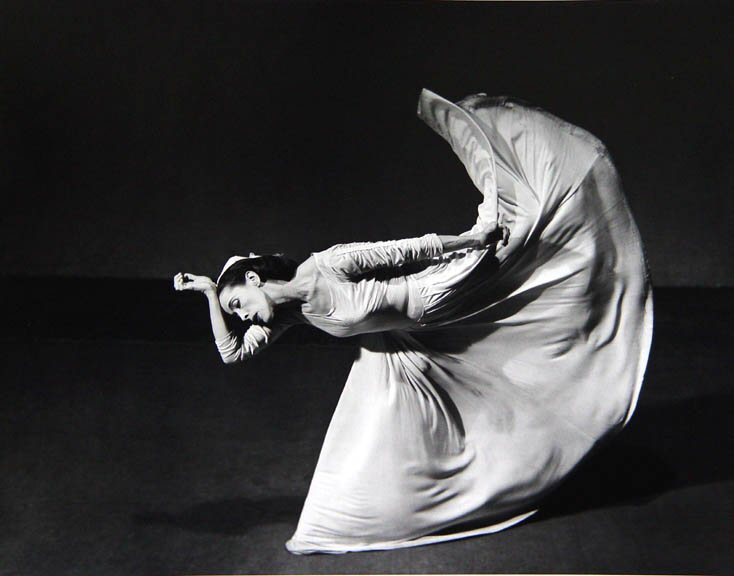
Letter to the World is inspired by Emily Dickinson's poetry and personality. Two are the protagonists, The One Who Dances and The One Who Speaks, the first dances the most beautiful phrases in the piece, while the second utters lines from the poet's poems and letters. The other characters represent aspects of her personality and icnlude The Ancestress, who embodies Puritanism and death, The Lover, who is an actual lover and her connection to the world and March who interprets her lively wit. The main narrative thread presents the dancing protagonist engaging a fight with The Ancestress to affirm her creative independence.
Monday, 29 April 2013
My International Dance Day
| Andy Warhol, Letter to the World - The Kick, 1986. |
This
research has now gained a significant political value as I have discovered that
it bothers numerous people and groups in the Italian and Anglo-American
academic world. It is centred on one of the most neglected Graham’s
choreographic works, Letter to the World, which is dedicated to Emily Dickinson’s
poetic personality. I therefore choose today to launch a kind of diary that can
trace the pathways I will from time to time go through to work on this project
and get it published. Good day, everybody!
Tuesday, 19 March 2013
Love in a Sweet and Sour Sauce - L'amore torna (Love Returns) by the Luna Dance Theater
LOVE IN A SWEET AND SOUR SAUCE
L’amore torna (Love Returns), Luna DanceTheater
Teatro Studio alla Mole, Ancona, 3 March 2013
![]() |
| Simona Ficosecco in L'Amore torna (Love Returns) |
Shoes, the heavy noise of
high-heeled shoes is the cacophonic intro to this ironic dance theatre piece.
Three women enter the stage stomping the floor with their high heels, stopping
mid-stage centre with their back to the audience and taking a deep breath. It
is the perfect opening for a piece about love, or better about the longing for
love that makes them suffer and dream during the whole piece. A piece that had
its debut in Sirolo near Ancona in 2011, was then presented in New York last
year, was now showed for the first time in Ancona where the company resides
and has been working since 1990 and will be in Palermo, Sicily, on September 1st.
Simona Ficosecco’s choreography is imaginative and lighthearted with beautiful solo pieces for herself and the two other dancers, Désirée Storani and Daniela Manetta, and energetic group pieces usually performed in unison. Her movement approach is characterized by effective repeated movements like the one in the initial part of the work, where the three dancers turn towards the audience as if to say or do something and then go back to their initial position or the one performed by Ficosecco while lying on the table, with her hands and legs frantically and insistently falling down and Storani putting them up again.
There are three main props that fill the small stage: a table, a wooden chair and a red sofa. Three simple props that give way to interesting choreographic patterns, like the bittersweet domestic scene where Ficosecco is asked to iron a big amount of clothes, a request she questions by ironing her hair instead. Or the lyrical solo she has created for Storani on the sofa, a solo the dancer performs with a male suit jacket, the only relic left of a love relationship which seems to be gone forever. Storani wears the jacket with its back on her bosom, smells it, lays on it on the sofa in an attempt to recapture her lover’s presence. Particularly interesting is the contrast created between her loose arm movements while on the sofa and her elegant and precise body articulation in her solo on the stage floor.
In another moment Manetta performs the funniest part of the piece which is centred on her reiterated need for alcohol. Love disappoints us and drinking seems to be the only way out. She asks Ficosecco for a glass of pinkish liqueur. She gives it to her, but Manetta continues asking for it, showing each time a different posture: standing, standing on the chair, standing outside the stage with her glass in her hand coming out of the wing, laying down and so on.
The atmosphere is a bit retro with songs being played like “Tu che m’hai preso il cuor” (You are my heart’s delight in English) that acquires a parodic twist when set against Ficosecco’s choreographic inventions. In particular, this song is played when Manetta places the chair on her shoulders and starts asking for alcohol.
Ficosecco performs maybe the most spectacular phrase in the piece, dancing in a red evening dress whose skirt is later tucked up so as to leave her legs bare and Manetta throwing a bucket of white feathers at her. Cristiano Marcelli’s direction is cleverly done with a refined lighting design which highlights Ficosecco’s choreography particularly well.
All in all Ficosecco plays with the stereotypical idea of love as a romantic ideal, as the perfect union of a (heterosexual?) couple. This kind of love will never return, because it does not exist. As Eva Illouz has remarked in her groundbreaking and much debated book, WhyLove Hurts, love is also "shaped by social relations and institutions” and unveils the sharp changes that took place in the relationship between men and women during the twentieth-century. It is a lot more complex and subtle than the one displayed by the institution of marriage. It then needs to be reassessed in different terms, with a changed approach to how we live our emotions and what we expect from others.
The end of the piece is, in this sense, paradigmatic with the arrival of a white dressed bride interpreted by Cristiana Taddei, followed by four male dancers, Manuel Di Gioia, Giovanni Galeazzi, Alessio Kgi Giaccaglia and Nicola Sabbatini. She sits on the chair showing her legs with them surrounding her, posing in macho-like postures and taking turns at kissing her forehead. It is funny and bitter at the same time as a sweet and sour sauce.
Men are the great absent characters in this piece, they are evoked through the above mentioned solo with jacket and in other phrases, but they only show up as the caricature of themselves in the final scene. Does this imply that they are seen as unreliable and immature? Possibly, at least on the surface. But it also highlights the fact that women exaggerate in investing too much of their time in preparing to meet them without really trying to interact with them. There are two funny scenes, in this respect, one in which Ficosecco places evening dresses on her own dress with clothes pegs, and the other with Manetta interpreting a fortune teller who reads the cards before Ficosecco goes to her date.
So what does the title Love Returns mean? It means a lot of things, it means that Love is a tremendous force that should be handled with care, it means it has many faces and not all of them are worth our energy and it means it should be lived with lightness and not with superficiality. Love is there, love leaves us, love returns…
Simona Ficosecco’s choreography is imaginative and lighthearted with beautiful solo pieces for herself and the two other dancers, Désirée Storani and Daniela Manetta, and energetic group pieces usually performed in unison. Her movement approach is characterized by effective repeated movements like the one in the initial part of the work, where the three dancers turn towards the audience as if to say or do something and then go back to their initial position or the one performed by Ficosecco while lying on the table, with her hands and legs frantically and insistently falling down and Storani putting them up again.
There are three main props that fill the small stage: a table, a wooden chair and a red sofa. Three simple props that give way to interesting choreographic patterns, like the bittersweet domestic scene where Ficosecco is asked to iron a big amount of clothes, a request she questions by ironing her hair instead. Or the lyrical solo she has created for Storani on the sofa, a solo the dancer performs with a male suit jacket, the only relic left of a love relationship which seems to be gone forever. Storani wears the jacket with its back on her bosom, smells it, lays on it on the sofa in an attempt to recapture her lover’s presence. Particularly interesting is the contrast created between her loose arm movements while on the sofa and her elegant and precise body articulation in her solo on the stage floor.
In another moment Manetta performs the funniest part of the piece which is centred on her reiterated need for alcohol. Love disappoints us and drinking seems to be the only way out. She asks Ficosecco for a glass of pinkish liqueur. She gives it to her, but Manetta continues asking for it, showing each time a different posture: standing, standing on the chair, standing outside the stage with her glass in her hand coming out of the wing, laying down and so on.
The atmosphere is a bit retro with songs being played like “Tu che m’hai preso il cuor” (You are my heart’s delight in English) that acquires a parodic twist when set against Ficosecco’s choreographic inventions. In particular, this song is played when Manetta places the chair on her shoulders and starts asking for alcohol.
Ficosecco performs maybe the most spectacular phrase in the piece, dancing in a red evening dress whose skirt is later tucked up so as to leave her legs bare and Manetta throwing a bucket of white feathers at her. Cristiano Marcelli’s direction is cleverly done with a refined lighting design which highlights Ficosecco’s choreography particularly well.
All in all Ficosecco plays with the stereotypical idea of love as a romantic ideal, as the perfect union of a (heterosexual?) couple. This kind of love will never return, because it does not exist. As Eva Illouz has remarked in her groundbreaking and much debated book, WhyLove Hurts, love is also "shaped by social relations and institutions” and unveils the sharp changes that took place in the relationship between men and women during the twentieth-century. It is a lot more complex and subtle than the one displayed by the institution of marriage. It then needs to be reassessed in different terms, with a changed approach to how we live our emotions and what we expect from others.
![]() |
| Désirée Storani in L'Amore torna (Love Returns) |
The end of the piece is, in this sense, paradigmatic with the arrival of a white dressed bride interpreted by Cristiana Taddei, followed by four male dancers, Manuel Di Gioia, Giovanni Galeazzi, Alessio Kgi Giaccaglia and Nicola Sabbatini. She sits on the chair showing her legs with them surrounding her, posing in macho-like postures and taking turns at kissing her forehead. It is funny and bitter at the same time as a sweet and sour sauce.
Men are the great absent characters in this piece, they are evoked through the above mentioned solo with jacket and in other phrases, but they only show up as the caricature of themselves in the final scene. Does this imply that they are seen as unreliable and immature? Possibly, at least on the surface. But it also highlights the fact that women exaggerate in investing too much of their time in preparing to meet them without really trying to interact with them. There are two funny scenes, in this respect, one in which Ficosecco places evening dresses on her own dress with clothes pegs, and the other with Manetta interpreting a fortune teller who reads the cards before Ficosecco goes to her date.
So what does the title Love Returns mean? It means a lot of things, it means that Love is a tremendous force that should be handled with care, it means it has many faces and not all of them are worth our energy and it means it should be lived with lightness and not with superficiality. Love is there, love leaves us, love returns…
Here a clip of the piece, which was sponsored by Amat within the Off/side Teatro del presente project, by the Ancona Municipality, the Vicolo Corto Company, Teatro Stabile delle Marche and by the Fondazione Teatro delle Muse.
Tuesday, 12 March 2013
Body Collision - Wim Vandekeybus' What the Body Does Not Rememer
BODY COLLISION
Wim Vandekeybus’
What the Body Does not Remember
Teatro delle Muse, Ancona, 22 February 2013
1987: WimVandekeybus creates What the Body Does Not Remember for his company Ultima Vez and presents it in at Inteatro in Poverigi, near Ancona. The work wins international acclaim and declares the Flemish choreographer one of the most interesting and exciting voices in the contemporary dance panorama.
2013:
Vandekeybus comes back in the Marche Region and presents
this piece again. It looks as provocative and stimulating as sixteen years ago
and is welcomed by an enthusiastic audience.
Body collide in
this energetic piece. They run from one side of the stage to the other, they
run one against the other, they walk, jump and frantically fight in an
atmosphere of instability and alienation. There are at least six different
sections highlighted by movement, light or props themes. The opening section is
utterly remarkable, with two rows of floodlights set on the side of the stage placed on the stage floor and two male dancers moving in between them. Their
movement then falls under the control of a sound a female dancer produces with
her hands beaten or even slightly positioned on a small red table backstage centre. It is hypnotic and mesmerizing.
Another section features the whole group of nine dancers interacting with white
bricks of different dimensions. They stand on them, they throw them at each
other, the throw them up in the air, they build small structures with them. If on
the one hand the atmosphere recalls that of a circus, on the other the dancers’
inability to establish endurable connections creates a sense of bewilderment.
Vandekeybus’s
movement approach looks approximate and imprecise, aggressive and fast, but it
is the result of careful study and concept. In another section the dancers walk
from backstage left to front stage right wearing, playing, throwing colourful
towels. It is an ironic section where the dressing and undressing of the
dancers represent a witty dynamic device.
Vandekeybus is
really good at making the most out of props, like bricks or even chairs, which
represent the centre of another section again characterized by a good bit of
irony. In one phrase a man sits on one of the two white chairs onstage and a
girl comes to sit on his knees. She falls asleep and he carefully takes his top
off without waking her up. It is a tender duo where an unusual Vandekeybus
emerges with respect to the tough dances he displays in the rest of the piece.
In yet another section there are three couples showing a drastically different movment quality, with the female dancers repeatedly standing with their feet and arms in second position and their male partners touching their bodies. In this case I found Vandekeybus's insistence on this body relation a bit too reifying for women, who could have for example done the same to their male partners. According to Judith Mackrell, "Vandekeybus doesn't write particularly inventively for women" and maybe this is one good example.
So what is it
that the body does not remember? Is it an everyday movement like wearing a
towel or sitting on a chair? Or is it the importance of communicating,
of establishing contacts between people? Maybe none of these and all of them at the
same time. I really enjoyed the display of body collision and the sense of
precarity (still so meaningful today!) intrinsic in the dance sections of the piece. The work was astonishingly good and the dancers a real marvel.
This event was also sponsored by Amat ad the Ancona Cultural Municipality.
Here a clip of the piece.
Saturday, 30 June 2012
Martha Graham in Love and War
Mark
Franko’s book-length study on Martha Graham is a much awaited and very welcome work.
As he notes
in the Introduction, Graham is often compared to Picasso or Freud, but
biographers, whose studies have been fundamental to frame her life and
achievements, “have not always given her work the quality or quantity of
analysis that has been devoted to Freud, Einstein, Picasso, Stravinsky, Eliot,
or Gandhi”. That is why Franko’s intention is to focus on her most productive
years, namely those between 1938 and 1953, with a specific attention to what
was happening in her life and, more precisely, in her relationship with Erick
Hawkins off and onstage. As he says, “it is appropriate and indeed necessary to
bring biography into relation with the analysis of production work”.
In
particular, he chooses four dance pieces, American Document (1938), Appalachian
Spring (1944), Night Journey (1947), and Voyage (1953), to investigate the relationship between Graham's life and work. The first and last
are quite unknown to the audience, while the second and third represent two of her most
popular pieces. He devotes to each of them a chapter filled with impressive analyses
fuelled by research that includes the consultation of unpublished material.
Franko’s
research unveils fundamental aspects of Appalachian Spring which
is stripped of its joyful rhetoric. Appalachian Spring is about a newly
married couple who is welcomed by the community into their new house. It is the
last piece Graham created on North American themes. Analysing material on the
creation of the work, Franko discovers that its original conception included
other characters, like the Indian Girl and the Fugitive. Throughout the working
of the piece, they were eliminated, but, in a way, their ghostly presence
remained in the piece. That is why the work is characterised by what he terms
“character compression”, in that each character is also the result of the
elimination of these characters who possibly survive in another character's movement quality or step or even in Aaron Copland’s musical score.
Another significant result of Franko’s research is his analysis of Night
Journey and Voyage in connection with the Graham-Hawkins relationship and, more
precisely, with their separation. The first is one of her signature pieces and
retells the Greek tragedy of Oedipus from Jocasta’s perspective, while the
second is one of her most unknown pieces, perhaps her most neglected one,
and is about “the effort to shed delusions”. Graham interprets the role of a
middle-aged woman who relates herself to three different men. In this sense,
she turns away from myth, which had been a kind of creative shield for her
since the mid-1940s and presents herself as a more vulnerable artist. That is why,
according to Franko, this work was not appreciated by the critics who were instead used to Graham’s magnetic power onstage.
As I said,
Franko does a marvellous job in putting the two pieces in relation to each
other. Graham was writing the libretto for Night Journey when Hawkins left her
for the first time for about a year and this event “had to influence Graham’s
vision of Jocasta in relation to Oedipus”. Hawkins then definitely left her in
1950 during their European tour which was cancelled due to Graham’s knee
injury. Voyage represents a creative elaboration of their
separation. Franko notes that “if Night Journey was an anticipatory ritual of
separation, Voyage was a post-ritual of becoming separate”. In particular,
Voyage “is unique in the annals of twentieth-century choreography because it
was conceived in analysis, and developed in a correspondence (and probably also
in conversation) with the choreograher’s analyst,” Jungian psychotherapist
Frances Wickes.
Because
Franko does not provide a thorough introduction to either Graham or her pieces,
his study may not be of easy access to those who are not familiar with her work.
However, the scope of his analysis and the richness of his findings, make it a must read for anyone interested in dance, cultural, and biographical studies as well as the creative process of a remarkable artist.
I would like to thank the Oxford University Press for letting me have an advance reading copy of the book before its actual publication.
Sunday, 24 June 2012
Lecture performance on Martha Graham
The Italian version of this post has first appeared on one of my other blogs, www.dancescriber.blogspot.com, at this address.

ADAM Accademia (Macerata Art Academy) celebrates Martha Graham twenty years after she passed away with a lecture performance created by myself on September 17th, 2011 in Civitanova Marche.
Martha Graham (1894-1991) has been one of the most important figures in the twentieth century, so much so that she has been compared to Picasso and Freud for the scale of her revolution in dance. Her work represents a fundamental stage in contemporary dance history: as has been said more than once, every dancer is Martha Graham's son or daughter, both in the case he or she has continued to work alonge the lines she created and in the case he or she rejected them, as it happened to Merce Cunningham, who danced in her Company for a few years.
Graham has been an extraordinary dancer, a remarkable choreographer and has created a dance technique centred on the movement of the torse, a technique which has questioned the supremacy of ballet and the idea that dance should only be an entertaining art. Before her, Isadora Duncan and Ruth St. Denis had questioned these aspects without producing lasting and structurally defined alternatives. Graham, on her part, has managed to delienate a creative corpus capable of facing a comparison with the rich tradition of ballet and with Broadway. Maybe it is for this reason that in 1959 the famous Russina ballet choreographer George Balanchine, father of the New York City Ballet, asked her to collaborate with him at the creation of his new piece Episodes. Many personalities have been seduced by Graham's charisma: Andy Warhol has recreated her image in famous serigraphies, Rudolf Nureyev and Margot Fonteyn have danced in some of her pieces, Liza Minnelli has acted in one of her works, Woody Allen and Madonna have both studied at her school.
The lecture performance on Graham is structured according to three lines: one dedicated to the verbal medium and interpreted by myself as dance historian (that is the proper lecture part of the whole event), the second centred on movement and performed by contemporary dancer and choreographer Simona Ficosecco and the third one devoted to sound and mixed by dj [Nooz]. Graham always created spledid collaborations with the people she worked with, such as set or costume designers. The idea is to create an unusual synergy between three different languages which are not usually put together to celebrate Graham's work and to unveil some of its flaws.
[the image above is a sketch I made taking as inspiration Graham's Lamentation, the graphic design is by Nooz]
Subscribe to:
Posts (Atom)