Victoria Thoms, Martha Graham. Gender and the Haunting of a Dance Pioneer (Bristol: Intellect, 2013).
Martha Graham's legacy is a complex question that can take many forms. Victoria Thoms's book delves into it in penetrating ways. Her monograph takes a (long-awaited, I would say) gender perspective on Graham, analysing her in relation to feminism, UK ballet, film, and queer culture.
Martha Graham is associated with the interesting concept of ghost not just because as a fundamental presence in dance history is much missed now, but also and most of all, because it is very hard to pin her identity down given the fact that her life and work have been very much shaped by myths nad legends. Thoms skillfully moves inside this ghost-shaped approach to Graham following the above-mentioned four threads, four spectre figurations that lead to a more profound understanding of what Graham's world means today.
The first spectre confronting Graham is the spectre of feminism, which is an endurable presence in her work in spite of the fact that she never fully aknowledged it. Thoms investigates Graham's ambivalent relationship with it, analysing her life and statements as well as the women who surronded her, like Frances Wickes and Katharine Cornell, other strong and independent women who could be associated with first wave feminism. As a consequence of that, a masterpiece like Primitive Mysteries dedicated to the Virgin Mary and her female followers, can be seen as the embodiment of a feminist consciousness in Graam's work, "even in the face of (...) [her] refusal".
The second spectre is her presence in the UK, a really haunting presence. Graham was neither accepted nor fully understood until the 1970s. In the 1950s, just after the war, it was important for England to rebuild a national identity and Graham's style did not fit into this plan. Ballet did. Margot Fonteyn did. Dance in this context served as a diplomatic tool which showed what each country could offer. And the UK chose ballet, their ballet, in particular Sadler's Wells ballet, which was seen as "a symbol of national pride". As a corollary to this aspect, there is the question of femininity that ballet dancers perfectly embodied, with grace and harmony as its qualities, while Graham's self-assertive heroines and percussive style portrayed a different kind of femininity, one that did not follow standards. The press contributed to shape this idea. For example Paul Holt saw Graham as "an American intellectual" who "put the human body into the most grotesque positions" and Cyril Beaumont said "arm and leg positions are deliberately distorted, steps often begin with the working leg (toe upward) thrust forward, pelvic tilts, constricted thorax and abdomen, and rolling on the floor".
The third spectre confronting Graham is film, an art form she engaged with late in her career with documentaries like A Dancer's World and filmed choreographies such as Night Journey. To Thoms, film constitutes a significant medium to study Graham as it "provided a greater mass access to Graham's works, both nationally and internationally". Furthermore, what they give us is Graham's aged body and, on a more general level, a peculiar notion of time, linked to "a sense of immediacy; a feeling of being-threre-ness". In this respct, if compared with photography, film does not leave as much space for the imagination, because the frozen image can let us focus on one single pose and, at the same time, think about what came before and what comes afterwards.
The fourth spectre is the least Graham herself would probably expect, as it has to do with queer culture and, more specifically, with two drag performances inspired by her iconic figure, Roy Fialkow's Lamentations of Jane Eyre and Richard Move's Martha@.... The concept of queer is defined as "a positive re-appropriation of pejorative non-normative
sexualities and applied to a diverse set of evolving areas of study and
activism around lesbian, gay, bisexual and transgendered identities". It is uncanny and particularly suitable to Thoms's discourse, also for the way she then analyses Move's non-drag Bardo, performed by Katherine Crockett, in connection with "queer mourning".
The book ends with a reflection on the "ghostly relationship between dance and writing", which requires for us to think in a different manner and go beyond essentialisms. This is a rich and exciting study, a must read for all those interested in cultural history, gender, and dance.
Saturday, 31 May 2014
Monday, 13 January 2014
Charlotte Trowbridge and Letter to the World
| Letter to the World. Drawing by Charlotte Trowbridge, 1945. |
Her drawings are neither figurative nor faithful representations of Letter to the World, but rather an insightful and stylised glance at “the frenzy which animates the dancer’s body frame from within,” as Graham noted in the Foreword. They are black-and-white minimal shade-less drawings, where perspective and proportions are replaced by the artist’s sensitive touch. Some of the spoken lines are printed with the drawings.
Unlike Morgan’s powerful photographs, Trowbridge’s drawings are feeble presences on the page, and do not necessarily follow the chronological development of the piece. The third drawing presents, in fact, the One Who Dances and the Lover at the bench (in the actual piece, the One Who Dances and the Lover are not seated at the bench in this moment) with the Ancestress at their back, ready to separate them, a crucial moment which takes place in the fourth section of the piece. On a couple of occasions, Trowbridge seems to have taken inspiration from Morgan’s photographs, as in a drawing of March, who is depicted doing his famous entrance jumps. Of particular interest, is the way Trowbridge portrays the One Who Dances in one drawing inspired by the final section, when she is desperate for the loss of the Lover: her face is lifted upwards, but her body is filled with hand drawings, that convey her inner turmoil. It is very evocative of the dancing protagonist’s state in that phrase.
Sunday, 5 January 2014
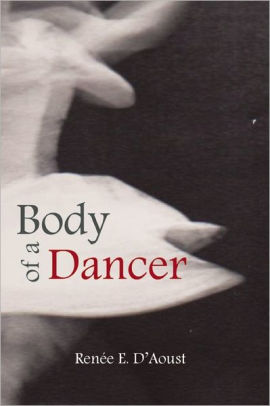
Body of a Dancer
Renée E. D’Aoust, Body of a Dancer (Wilkes-Barre: Etruscan Press, 2011).
As D’Aoust does not make it into the Graham Company, she leaves to find a job in other dance companies, taking classes at various studios where different choreographers taught as “you hoped someone noticed and asked you to dance with them”. Her description of auditions is particularly insightful. She danced, among others, for Mary Antony and Kevin Wynn. In particular, while working for the latter, she got to know Liz, also called Bruce Lee, because she was a tough and commanding dancer. A dancer who committed suicide: “In the end, Liz’s boyfriend, also a dancer, / found her in her loft apartment. / (…) Once he enfolded her body into his, the way they had practiced many times, there was nothing left to do but cry”. The way the author builds the narrative about Liz's talent and commitment up to the moment when she ended her life is moving and powerful. Suicides, she affirms, "is not always a cry for help (...). Sometimes it's an understandable release".
Dancers do not often speak their voice and clichés are then difficult to question. In this respect D'Aoust expresses her viewpoint frankly and, at times, remarkably well, dissolving clichés in the span of a few words.
Writing about
dance is not easy. Writing about dance in a memoir is probably even more
difficult and, when you find a cleverly written memoir which is also about leaving
dance as a profession, you face a book worth reading. Why is that? Because the tone used to talk about dance is too often mistic, romantic, passion-driven and absolute, as if without dancing one could not live. And one wonders, what about all those who at one point in their life decide or are kind of forced to leave the profession? What about them? What do they feel? What do they think? What do they do?
Renée E.
D’Aoust’s memoir is beautiful, ironic, sarcastic and
intense. She trained as a professional dancer in New York in the 1990s and, if at first sight this sounds a thrilling and exiting thing, once you take a closer look, you realise it is tough, precarious and nervous breaking.
I find the title
particularly apt as she highlights the way in which her body responded to
different dance techniques and to her life-changing decision to leave dancing.
D’Aoust’s first
love was ballet, so much so that when she left it to go and study dance in New
York, she left her identity and felt as if she had failed: “I did not have the
biology. My extension was not high enough. I had breasts. I would never be a
ballet dancer. I was nothing”.
In the Big Apple
she gained a scholarship to get into the Martha Graham School of Contemporary
Dance (a much wanted achievement) and her adventure began. It is entertaining and funny to read her view on
the technique, “the Graham contractions hollows out the abdomen so that it
looks like a sail filled with air. The spine is the webbing of the sail and the
legs are the ropes. I contracted” and on some of Graham’s famous statements,
“The body, Martha Graham says, never lies. My body lied all the time. (…) I
didn’t tell anyone I used to spend days in bed or on the floor, trying to get
my lower back to release various spasms”.
Her scholarship
only covered tuition fees so that she had to find a way to support herself.
And she did so by doing eight (yes eight!) different jobs, that included being a bathroom
attendant girl for a Catering Company and a Sunday employer at a Freudian
psychiatrist’s studio.
D’Aoust also vividly
introduces us into the life of her dance mates at the
Graham Centre. She speaks of Daniela, who concentrated so much on a
choreographic piece inspired by Stravinsky’s The Firebird that one day she
actually “stepped out of the window”, and of Mara, the goddess, “partly because
she had bodacious breasts, partly because she always had a new lover, partly
because she was from Argentina, but mostly because we adored her”.
As D’Aoust does not make it into the Graham Company, she leaves to find a job in other dance companies, taking classes at various studios where different choreographers taught as “you hoped someone noticed and asked you to dance with them”. Her description of auditions is particularly insightful. She danced, among others, for Mary Antony and Kevin Wynn. In particular, while working for the latter, she got to know Liz, also called Bruce Lee, because she was a tough and commanding dancer. A dancer who committed suicide: “In the end, Liz’s boyfriend, also a dancer, / found her in her loft apartment. / (…) Once he enfolded her body into his, the way they had practiced many times, there was nothing left to do but cry”. The way the author builds the narrative about Liz's talent and commitment up to the moment when she ended her life is moving and powerful. Suicides, she affirms, "is not always a cry for help (...). Sometimes it's an understandable release".
Dancers do not often speak their voice and clichés are then difficult to question. In this respect D'Aoust expresses her viewpoint frankly and, at times, remarkably well, dissolving clichés in the span of a few words.
After dancing for Wynn, her body "felt, complete somehow. Finished and complete. And not bitter at all". That is when she stops dancing. That is when the hard work to keep her body trained and fit starts to be used to do something else. That is when her life changes for good.
D’Aoust ends the
book with two dance-related episodes: when she goes to see the Graham
Company perform after she has left dancing and when she goes to pay a
visit to Isadora Duncan’s grave in Paris. In the first case, she extensively
talks about the dancers she danced with and their performance, interestingly calling
that chapter, “Dream of the Minotaur”, thus recalling Graham's labyrinth-inspired masterpiece "Errand into the Maze"; in the second, she poetically removes her sandals, taking some photographs of her
bare feet and draping her scarf over her right foot, as if to honour the revolution operated by the great bare-feeted dancer who tragically died strangled by her own scarf. No end could have been more perfect.
Friday, 13 December 2013
Carmen and Dance
![]() |
| Leaflet of the lecture performance. |
| Michela Fossà, Rosella Simoanri, and [Nooz], photo M. Piccinini. |
In 2012 I created a lecture performance on this topic, titled "Carmen and Dance", which has been presented as part of an art festival in Macerata (here the link to the photographs of the event). With it I intended to explore the relationship between Carmen and dance in the novella, the opera and in the above-mentioned choreographic peices, with an added reflection on the relationship between woman, dance, body. It has been thought to let three languages interact in the same space and time: the verbal, organised by myself, the corporeal, danced by flamenco dancer Michela Fossà, and the aural, played by dj [Nooz].
| Michela Fossà during the lceture performance, photo M. Piccinini. |
Monday, 2 December 2013
Fang-Yi Sheu as The One Who Dances in Graham's Letter to the World
| Fanf-Yi Sheu in Letter to the World, photo by Christopher Duggan. |
It is a very precious video as it gives a glimpse of what the piece could look like today. The Graham Company has, in fact, not recosntructed and performed it since 1988 and the only video available to the public is in black and white at the New York Public Library for the Performing Arts, with a stunning Pearl Lang in the title role.
This solo presents the main character as a lively and inexperienced girl in search of her path. She moves in different directions, runs, stops, moves again. She performs some beautiful turning jumps that are highlighted by her wide skirt, bends her torso forward several times and dances a brief section at the bench (during the piece she will return to the bench in more than one occasion). It a real joy to be watching this section in colour (I have studied the black and white video for my research)!
This readapted solo (there are variations and changes here and there) stands up as a nicely crafted choreographic piece and is very precisely danced by Fang-Yi Sheu, but, at the same time, we need to remember where it comes from. In the piece, the One Who Dances was with the One Who Speaks before beginning her solo. Her presence is only evoked through Dickinson's quoted lines: "Not knowing when the dawn will come, / I open every door", taken from poem 1619. The presence of the One Who Speaks is very important and instrumental to the developemnt of the piece. She is the other Emily, the speaking Emily, the one who moves more sedately but with equal force. And the lines are very important too. They convey the evolution of the main character's "inner journey", as Graham would say.
I am very pleased about this little choreographic passage and hope Letter will soon be reconstructed in its entirety.
Wednesday, 13 November 2013
On the term 'choreosophy'
The term 'choreosophy' derives from Greek 'χορός' (choros, dance) and 'σοφία' (sophia, knowledge) and indicates a layered system of knowledge that we have on dance. The term joins together the word 'dance' and 'knowldge', as if to imply that the art of dancing is capable of producing knowledge, an important aspect if we think that still today many people tend to limit the meaning of dancing to the mechanical movement of the body (which could also be a topic for discussion, but not in this article).
The term 'choreosophy' was used by dance theorist Rudolf Laban in his book Choreutics (1966), together with other terms such as choreography and choreology, on which I will return in another article. Laban mentions its use in ancient Greece: "choreosophy seems to have been a complex discipline in the time of the highest Hellenic culture" (Laban, 1966: viii) and he also talks about its use in Pythagoras's work (the word 'choros' also means circle).
In another book, The Art of Movement (1950) Laban had also coined the poetic expression "movement-thinking" where again a term like 'movement' was put next to 'thinking' to suggest that dancing can be connected to the intellect and can move the articulation of thoughts.
The term 'choreosophy' returns in choreographer Aurel Milloss's writings as he defines it "the discipline that deals with dancing from a moral point of view" (Milloss, 2002: 64). In this case, then, the word 'knowledge' is interpreted in a different manner with respect to my definition. Milloss goes on specifying that choreosophy "intends to analyse the apparitions and manifestations of dance in human life" (Milloss, 2002: 64), giving a mystic tinge to the term. Dance, in his vision, is seen as the art from which the other arts originated as they all share a movement of some sort, "from the rhythm of movement came dance, from the rhythm of words, verses, from the rhythm of sound singing and music" (Milloss, 2002: 65). Having the other arts derive from dance is not new, Curt Sachs had already expressed this notion in his World History of the Dance (Tomassini in Milloss, 2002: 65). Establishing a hierarchical scale among the arts in the present academic panorama where Deleuze's molecular philosophy is widespread and where the binary vision of reality is being questioned, does not make sense and I will not venture on a digression of this kind. Suffice it to say that to Millos choreosophy is an analytical instrument connected to dance as a human phenomenon.
The word 'choreosophy' can also be found in Alessandro Pontremoli's writings about the fathers and mothers of contemporary dance, as he defines their work using the expression "choreosophic thinking"(Pontremoli, 2004: xxi). He also mentions it when talking about Laban, stating that choreosophy is the "philosophy of dance" as it "establishes its ethical and aesthetical principles" (Pontremoli, 2004: 70).
Recently, the term 'filmosophy' has been created and Daniel Frampton has written a book about it, Filmosophy published in 2006. Frampton highlights the fact that films do not only reproduce reality but create a new one (Frampton, 2006: 5). Films have produced a new way of thinking
(Frampton, 2006: 7) so that the necessity has come to reflect on them in terms of 'mind' and 'thinking'
(Frampton, 2006: 10). His discourse is quite interesting, but seems to fall back into the mind/body dichotomy, for example omitting the analysis of film materiality. The term 'filmosophy' is for Frampton exclusively connected to intellectual questions, while choreosophy, as we have seen, focuses on knowledge that dance can produce integrating mind and body in a refined synergy.
I believe it would be more appropriate to use the term 'choreosopher' instead of 'choreographer', when talking about great figures in dance history (and maybe not only them) who have developed a choreo-thinking within their work, (in the twentieth-century we can mention Martha Graham, Merce Cunningham, Trisha Brown, Anne Teresa de Keersmaeker, Tero Saarinen and the Abbondanza Bertoni Company), as this would express a more articulated picture of their vision.
Dance has its own terminology and 'choreosophy' is one of the less used but most stimulating terms to underline the complex research that surrounds the moving body.
(Note: tranalsations from Italian are mine. This article was originally written in Italian and published here)
REFERENCES
Daniel Frampton, Filmosophy - A manifesto for a radically new way of understanding cinema (London: Wallflower Press, 2006).
Rudolf Laban, L'arte del movimento [o.e. 1950], trad. Silvia Salvagno (Macerata: Ephemeria, 1999).
Rudolf Laban, Choreutics, edited by Lisa Ullmann (London: MacDonald&Evans Ltd., 1966).
Aurelio Milloss, Coreosofia - Scritti sulla danza, edited by Stefano Tmassini (Venice: Leo S. Olschki, 2002).
Alessandro Pontremoli, La danza. Stroria, teoria, estetica nel Novecento (Bari: Laterza, 2004)
Tuesday, 12 November 2013
Lecture performance on Martha Graham (photos)
![]() |
| Nooz and Rosella Simonari, photo Cristiano Marcelli. |
![]() |
| Simona Ficosecco, photo Cristiano Marcelli. |
![]() |
| Poster of Macerata ospitale festival, 2011. |
These are
two pictures from the lecture performance on Martha Graham that I
deliveredin Civitanova March on September 17th, 2011. The third image
refers to the festival that included my lecture performance among other
events. Here is the link to the press release of the lecture and here are some more photographs from the event.
Subscribe to:
Posts (Atom)